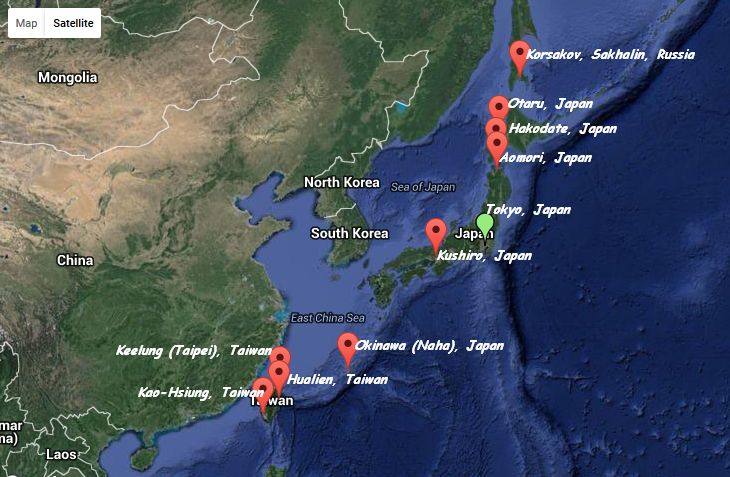

Japan (2016) Diary

3-6-2016
Friday 3-6-2016 Friday
We got up early to close up house and catch our 7.15am taxi to the airport for
our mid-morning plane to Tokyo, Japan. After checking in we bought our
duty free liquor for the trip and had some breakfast while we waited. It was an
8 hour direct flight, arriving at 7pm at Narita International Airport, so not
too painful, but by the time we waited for our bus and the more than an hour
ride to Tokyo railway station from where we then had about a 500 metre walk to
our hotel, arriving there a little after 10pm, we were quite weary. Our hotel is
Sotetsu Fresa Inn and we are here for 12 nights.
Our room is very, very tiny with no room to swing a cat and probably not as big
as the inside of our motorhome. We found the bathroom quite small, the low bed
and pillows quite a bit harder than we are used to or like, but got used to them
after a couple of days. In fact when we came back from our days' walks quite
tired and weary, they felt pretty good!
4-6-2016 Saturday
It was a bit rainy this morning as we wandered down to the very large and
impressive Tokyo Railway
Station, built underground with a big shopping
complex built alongside of it, as well as shops above it at street level - it is
quite extensive with 3 main entrances, Central, North and South. We walked
around most of the day really tiring ourselves out. Not far from the Tokyo
railway station is The Imperial Palace where the Emperor and his family
live. Many black expensive cars drove in through the manned gate (probably been
out shopping) and the palace buildings which are bordered by ancient and unusual
looking rock walls (previously a castle) and water (like a moat).
We walked through the beautifully manicured Kokyo Gaien National Garden
with several periodically activated fountains and one waterfall. An impressive
statue of the Kusunoki Masashige, atop a stocky horse, appearing to be in
full gallop and battle mode. (1294 – July 4, 1336) He was a 14th-century
Samurai who fought for Emperor Go-Daigo in the Genko War. He put us in mind of
the Mongolian soldiers we've seen in the movies. Further along is the Nijubashi
Bridge near which The Sanno Festival will be held next weekend. We are
looking forward to seeing it. Further along we came upon an area called The
National Diet, a large area of government buildings, one in which the
Japanese Prime Minister lives, and nothing to do with food 'diet' and not sure
what this word means in the Japanese sense.
5-6-2016 Sunday
This morning we caught the Hop-On-Hop-Off red bus, doing one route before
lunch and another afterwards. A few of the sites along the way were the white
and oranged painted Tokyo Tower - a communications tower looking very
similar to the Eiffel Tower and the tallest until the Skytree tower was built; Fuji
Television Aqua City Odaiba - a building made to look like a television with
a big sphere at the top; The Big Wheel like the Brisbane Eye or the
London Eye - 1 revolution apparently takes 16 minutes; Rainbow Bridge -
similar looking to the Sydney Harbour Bridge, and named so because at night it
is lit up with coloured lights and is quite a spectacle; The Skytree Tower
- another communications tower which is 634 metres tall and the world's tallest
tower. In 2011, it was certified by the Guinness World Records as 'the tallest
tower in the world'. (5 years on it may not be now??) We got off the bus and
paid to go up to the Tembo Deck (not the highest you can go) where we had 360
degree views all over Tokyo - impressive! In the distance Mt Fuji was obscured
by what appeared to be smog, although Tokyo did not appear to have a smog
problem at all. By paying an extra $10 each we got express progress to the lifts
and up the tower - good in our case as otherwise it was a 40 minute wait which
we didn't have, wanting to catch the next available red bus. There were a lot of
people up there, going up and coming back down, but it was all handled in a
quick and orderly manner.
On the way back we went up to the 6th floor of the KITTE building which
seemed to be a normal building of businesses and shops but the 5th floor was
free to anyone to go up to and showed some good views, especially where the
Bullet trains were waiting at the station. This was particularly interesting to
us because we are going to do some trips in them. Walking further on our way
back to the hotel, we came across a sight that we'd heard of but hadn't yet seen
- amazing compact, elevator parking garages. Space is so limited in Japan
that there are some parking lots that are actually high rise buildings,
sometimes 10 stories or more. You drive your car through a doorway, onto a
platform, and like a ferrish wheel it then turns to reveal the next vacant spot
(you can only see one parking platform at a time). On return your car is brought
down, you reverse it out, and if necessary where space is limited, a turntable
revolves until you are facing the right way to drive away....very efficient and
a wonderful spectacle!
Having covered a lot of area around Tokyo in the 2 bus routes today, we
concluded that the place is very clean, no rubbish lying around and the streets,
traffic, people, pedestrian crossings, etc, are all very orderly and promote a
welcome sense of safety. The population of Tokyo is about 37 million people. As
we walked and bussed it around Tokyo we noticed there are small designated
outside smoking areas, and people (mostly) don't smoke as they walk down the
street. We don't know if that's just in Tokyo or throughout Japan. There are
zebra pedestrian crossings at just about every corner, traffic light controlled
or not, but today we encountered one that was the largest we'd ever seen! It
would've been the width of about 4 of the others, outside the main Tokyo railway
station. I couldn't stop looking at it!
6-6-2016 Monday
We caught the Hop-On bus this morning to get us to the Tsukiji Ginza stop
where the Tsukiji Fish Market (wholesale) is located. They have an
auction on the fresh fish (including enormous tuna) every morning at about 5am,
and then what's bought is sold (in an adjacent area under the same roof) to
retailers who then resell at their smaller shops at the shopping markets, not
far away. We were able to walk through this auction and wholesale reselling area
but there wasn't too much to see. We were surprised that the place didn't stink
- possibly they have it washed so quickly and efficiently that this isn't a
problem. Walking through the retailing markets area we saw all sorts of products
including squarely cut pieces of tuna, other fresh fish, smoked herrings, fresh
and cooked crabs and prawns, big fresh and cooked King crabs, dried fish
including sardines and smaller white bait, sea urchins, and so many other
products! We tried a dish that was being cooked at a stall by a lovely young
Japanese lady who spoke English very well - it was 2 sea scallops on a skewer
with sea urchin and crab meat on top. The sea urchin was mustard in colour and a
little bitter - not a favourite. We also tried some other cooked delicious
seafood on a stick as we walked through (one with corn and mixed in with fish
cake and one that appeared to be long thick pieces of calamari with a coating of
some sort). One narrow laneway was so packed with people we were glad to get out
of there. I said to Dave that it'd be good if the Japanese liked to eat our
similarly-looking (damaging) Crown of Thorns Starfish that are a threat to the
Great Barrier Reef - that would kill 2 birds with 1 stone!
We walked further to the Ginza area but didn't see too much we were interested
in so started to make our way home. On the way we could see an interesting
shaped building in the distance, so walked to it. It turned out to be the Tsukiji
Hongwanji Buddhist Temple - quite an impressive building and lovely
altar/shrine inside. There was a pleasant incense smell as we walked up the
steps to the entrance, and just like any other church, inside there were chairs
with people sitting, praying, enjoying the peaceful surroundings.
7-6-2016 Tuesday
Dave found this snippet when googling Japan:-
"Eating, loud conversation and talking on the phone on the train will earn
you dirty looks.
Texting and falling asleep on the shoulder of the stranger next to you are okay.
During morning and evening rush hour, certain cars on express commuter trains are set aside for women only; they're marked by pink signs on the platform.
Groping on crowded trains, while not rampant, does happen."
We caught the local train today but neither of us experienced any of the groping
but on the way home this afternoon, the young lady next to me was falling asleep
and leaning on my shoulder a bit. I didn't mind. I felt compassion for her,
tired after a hard working day - it took me back to my working/train catching
days (many moons ago) and dropping off, sometimes missing my stop.
We had to pack up our bags today and leave them at reception for the day,
because we had to book back in to another room this afternoon. Dave had made an
8 nights booking originally but later realised we really needed some more days
as there's so much more we'd like to see. They couldn't extend our first booking
in the same room so had to have a different one for 4 nights, and the only ones
available were smoking ones, and you could smell the stale smoke every time you
came in. The new room is just as small but a slightly different layout which
actually makes it a bit easier for us to move about more freely.
We trained it (subway) to the town of Ueno (Japan) morning bought a 24hr
ticket for about $7 each which allowed us to catch as many trains on the Metro
line (2 different lines) as we wanted gave ourselves a bit of leeway to move
around, change plans and if we made a mistake a caught the wrong train (it's
been known to happen). The train system is very good and fairly easy to
navigate, similar to what we've experienced in other countries. It started
raining after a sunny start to the day so lucky Dave decided to keep the
brollies in his back pack. We walked through the large Ueno Park and saw
temples, including Kiyomizu Kannon Temple, gardens, 2 very good
buskers
playing standing xylophone instruments, and surprisingly saw in a quiet, shaded
area between a tree and a wall, what appeared to be a homeless setup with a
makeshift tent and umbrellas shielding the entrance. Homelessness here, is not
common so far where we've been. Leaving the park we walked up the street and had
a really nice lunch at a Chinese restaurant.
After lunch we caught the subway train 3 stops further to the town of Asakusa
(Japan). Walking around the town we saw in the distance (and also saw it
from the Hop-On bus recently), The Asahi ‘Flame’ on top of the
brewery building on the Asakusa banks of the Sumida river. It is infamous in
Tokyo for its eponymous ‘flame’, a huge golden piece of art juxtaposed atop
the obelisk-like black building; intended to represent the freedom and grace of
a good head of foam on a glass of Asahi beer. It has however been dubbed by many
the ‘flying golden turd’ or ‘golden tadpole’; another sad instance of
too much art-like sensibility and not enough common sense.
We made our way to the Asakusa district - entry gate (closed for repairs) to the
Sensoji Ji Shrine. Inside and past the shopping area, is this very big
and impressive shrine and you could smell incense burning everywhere near the
temples and many locals in traditional
dress. Just through the gate there were some smaller temples and plenty of
very busy shopping areas. These were side by side type shopping stalls where we
found some good souvenirs. Here we also saw a small scale (soft) biscuit
making and individually wrapping (all in one) machine, pouring out products
and being sold in a bag of 10 to the crowd - very interesting. We bought some
but asked (with sign language) at the same time, if it was ok to photograph (I
did a video) and the guy consented. We have seen many, many places selling these
soft, cake like, fondant filled treats, and are so surprised why the majority of
the Japanese people are quite slim. As well we've seen a lot of school kids in
uniform, buying these sweets and other lollies/sweets from plentiful lolly shops
everywhere, but very few kids are overweight.
8-6-2016 Wednesday Hiroshima and Miyajima Island
We
left the hotel at 7am this morning to walk to the Tokyo station and catch 2
Shinkansen Bullet Trains, (changing to a different one at Shin-Osaka) the high
speed trains to the town of Hiroshima (Japan) (old name for Hiroshima was
Gokamura) all up taking 5 hours to our destination. They travel at well over 300
ks per hour. We could see Mt Fuji in the distance but it was covered in cloud.
The scenery was mostly dense housing alternated with lots of rice fields. Even
where there's quite a few houses there were rice fields, like in their back
yards - I suppose a bit like we'd have our own veggie gardens. We brought
nibblies breakfast on the train but a lady with a trolley does walk down selling
drinks and some food. We had very comfortable seats as Dave had bought the 1st
class (Green) weekly ticket before we left home (which can only be bought before
leaving home) - a Japan Rail Pass (especially for tourists and foreigners), and
this also allowed us to reserve our seats beforehand (like the day before) and
we didn't have to line up and take pot luck with 'cattle class' unreserved seats
in unreserved carriages.
When we arrived in Hiroshima we caught the Hop-On-Hop-Off red bus and we got off
at 3 different places. The first was The Atomic Bomb Dome - it was called
the Hiroshoma prefecture Industrial Promotion Hall. There was probably only
about half of a shell of a building with its original dome on top, one of the
very few buildings left when the atom bomb was dropped on Hiroshima in August
1945, which basically ended World War II. This shell remains as a reminder of
the tragedy of war, a symbol to strive for eternal peace, and is registered on
the UNESCO World Heritage list. Next was Hiroshima Castle built circa
1589 and housed many Shogunates - Japanese Bakufu, or Shōgunshoku,
government of the Shogun. The Shogun was the title given to the supreme military
commander. There were 5 floors, all stairs no elevators, and all sorts of
memorabilia, swords, samurai uniforms, history of the castle and its commanders,
etc. Our last stop was the Peace Memorial Park showing many different
memorials resulting from the atom bomb. One was a 2 and a half metre (8 feet)
grass covered mound under which 10s of thousands of bodies were buried - very
sobering!
Then we took the local train 30 min trip, a 5 min walk to the ferry and then the
10 min ferry over to Miyajima Island and Hotel Kikunoya for 1
night. As the ferry neared the island we could easily see the impressive reddy-orange
(vermillion) coloured O-Torii Gate, the iconic symbol of the island. It
is the gate to the Itsukushima Shrine, is 16.6 metres in height, weighs
about 60 tons and stands under its own weight. The colour is considered to keep
evil spirits away. As we left the ferry and made our way, there were deer
roaming around freely, begging for food and even coming up to you and trying to
take it out of your hand if you weren't careful. We were being accosted by
2-3 of them trying to get our ice creams and they even tried chewing on Dave's
shirt sleeve! One deer took some paper out of a woman's hand and ate it!
They aren't scared of people at all and resist our shooing away efforts.
The tide was out and people were walking on the sand around the O-Torii Gate so
we joined them. It was the only time we would've been able to do this while we
were here as the tide would be in later, and when we left tomorrow. When the
tide was in, this huge gate looked like it was floating on water. There were
coins on the sand around the gate and also stuck in the algae and moss growing
on the pillars of the gate. Obviously this must be good luck. There were many
groups of school kids on the island, obviously a popular excursion, and we saw a
group that weren't Japanese - they were from Geelong in NSW!
We found our hotel and found out it was a Japanese
Ryokan one. We didn't
know what that meant. We'd seen on our receipt before we left home that it was a
shared bathroom but we just thought it was similar to a caravan park where the
shower block has individual showers and toilets but no, this is not the case! A
Ryokan has 2 or more large common bathrooms, one for men and one for women, and
it is customary in Japan to take baths together with other guests staying at the
hotel!! Dave used it (no one was in there he said) but he's used to doing that,
being an ex-lifesaver, but it was definitely not my thing! Luckily there was a
sink in our room and I just had a 'cat's lick'. We walked to a place for dinner
and went to bed early - it was a long day.
9-6-2016 Thursday
We left the hotel this morning and it was raining. We walked through the vast
Itsukushima Shrine, dedicated to 3 Munakata goddesses, worshipped as deities of
sea, traffic safety, fortune and accomplishment. We saw a few people in the
traditional Buddhist dress of this area. We walked up quite a few stairs to the
impressive Five-Storied Pagoda but it wasn't open to view. Next to it was
the Toyokuni Shrine (a.k.a.
Senjokaku), very old (no date given). Dave
went inside but I didn't as I didn't feel like removing my shoes.
We caught the ferry and local train back to Hiroshima, and then unfortunately
boarded the wrong Shinkansen train, only realising it when it started moving off
about 10 mins before our tickets said it was scheduled. Luckily the conductor
helped us with what trains to change to, so we could get back on track. When we
got off the train at the stop he suggested, I went to get the new tickets but
then got disoriented and couldn't find my way back to where Dave was waiting. I
got very flustered but luckily finally found him, but we missed that train! I
think there is so much that is new, different and foreign to me that my poor old
brain just couldn't cope. We both then went to the ticket office and got new
tickets (luckily we don't have to pay for them - the Japan Rail Pass covers it).
All turned out ok though - we just arrived back about 1 and a half hours later
than we would have, and that wasn't so bad travelling in the wonderful reserved
seating.
Something to ponder - on the Shinkansen trains their announcements say
"This is the Super Express - stopping at all stations to
......" The meaning of 'express' to me is that it doesn't stop at all stops.
10-6-2016
Friday Rest Day 10-6-2016
Friday Rest Day
It'd been a week since we left home and we've been on the go every day, so it
was time for a rest day, catch up with photos and diary, and give our feet and
backs a rest too. We started the day with a nice buffet breakfast at the Katsuki
Bistro (which appears to be part of the hotel but also open to the public).
About mid afternoon Dave went up to Tokyo railway station to get our tickets for
our Shinkansen trip tomorrow. After getting a few things at the supermarket, we
stopped in for happy hour and dinner at the GYO Standing Bar which is
just around the corner from our hotel. It's a popular place with many people
dropping in after work (in suits) for drinks and food. It is only standing, no
chairs, and smoking is allowed. In Tokyo smoking is not allowed in the streets,
only in designated smoking areas. There was only one customer who was female
other than me, and our waitress. It's a small place and it's a good name because
there really is only standing room and the atmosphere is good. Here we had our
first sake (pronounced 'sarky') drink, Japanese rice wine made by
fermenting rice - rocket fuel! Dave likes it and maybe might have to buy some on
the way back home.
11-6-2016 Saturday
Up early this morning as we left the hotel at 6am to catch the Shinkansen train
to the lovely seaside town of Matsushima (Japan),
about 366 kms north but only 1 and a half hours away on the high speed train.
There were 2 engines joined together pulling 17 carriages - later they would be
separated and go separate ways with a number of carriages. They are a funny
looking engine with a sloped front that looks to me, like a caricature of a
duck's head and bill (assumably for aerodynamic efficiency). We arrived in the
town of Sendai (Japan) where we then took a local train (snail rail -
more what we're used to) for a 40 min ride to Matsushima. The 2011 Great East
Japan Earthquake and tsunami greatly affected Matsushima, but the many barrier
islands spared it from the destruction and loss of life experienced by other
coastal towns. This same tsunami caused the destruction of the nearby Fukushima
nuclear power station and the (permanent) evacuation of the surrounding
residents.
We bought a ticket on a sightseeing boat for a 50 min cruise around the bay. In
the water there were nice sandstone looking, tree topped rock formations which
put me in mind of the 12 Apostles (although a lot smaller) off the Victorian
coast of Australia, along the Great Ocean Road. There were many oyster farms
with boats out harvesting and we had seen how big they were back at the
restaurants - very large teardrop shaped ones. We had a nice lunch and Dave had
a variety of (smaller) cooked and crumbed oysters, with one of the very large
raw ones, and he said it was very nice. During the oyster season from late
October to March you can enjoy all you can eat grilled oysters at 'oyster
shacks' (kakigoya) - Dave wishes we were here at that time!
Afterwards we walked around and visited the Zuiganji Temple Caves - one
of the most famous Rinzai Buddhist Zen temples in northern Japan. Caves have
been carved into the rock along with other decorations above the openings. The Godaido
Temple is named for the 5 Buddhas of wisd om housed within. Leading to the
temple are 3 unusual red bridges with spaces between the planks - if you trip
you are not yet ready to reach the temple! We caught the local train back to
Sendai and hopped on their City Loop Bus (sightseeing) which is called the Loople
Sendai - funny name to us, sounds like loopy, and there were a couple loopy
things about it. It was a small bus and pretty much packed with people all the
time so not great, and lucky we got on at the main train station so we managed
to get a seat. Anyway when you got on the bus you entered through the middle
door and didn't pay yet. When you got off you had to make your way down to the
front, through all the standing sandwiched people, to pay the bus driver at that
time - quite the reverse of what we've seen on other buses here and other
countries. I could imagine there'd be a few unscrupulous people who would just
get off through the middle door and not pay, and I doubt the driver would know.
Luckily we didn't have time to get off anywhere so didn't have the problem of
squeezing back on.
We were early back at the Shinkansen station and were able to change our tickets
for an earlier train, arriving back in Tokyo at 6.16pm.
12-6-2016 Sunday
This morning I was still lying in bed, slowly waking up, and Dave was on the
computer. I felt the bed all of a sudden start to shake and thought he was
trying to wake me up. I was just about to admonish him when he said his chair
was shaking and he thought we were in the middle of an earthquake!! We're on the
12th floor (the top) of our hotel so a long way to go. He quickly Googled it and
the record of it was already there (below). Wow we've never been in an
earthquake before!
A magnitude-5.0 earthquake has rocked eastern Japan, but no tsunami warning was
issued, the Japan Meteorological Agency says. The quake shook buildings in Tokyo
and the surrounding areas but there were no immediate reports on casualties or
damage to property.
The seismic centre of the quake that shook the region at 7.54 am local time was
in the south of Ibaraki prefecture, east of Tokyo, the agency said. The quake
struck at a depth of 40 kilometres.
Occurred at (JST) 07:54 JST 12 Jun 2016
Latitude (degree) 36.0N
Longitude (degree) 139.9E
Depth 40 km
Magnitude 5.0
Region Name Ibaraki-ken Nambu
This morning we went to Tokyo railway station to get some tourist info and book
Shinkansen tickets to Kyoto for tomorrow (Monday). We had some lunch and walked
around until the Sanno Festival main parade - the Shitamachi Rengo Mikoshi
Parade, which is one part of The Sanno Festival held 7-17 June, and marks the
start of Tokyo's summer festival season. It was a lovely sunny day and many
people came out for it. There were groups of people with their Mikoshis (15 in
total), practising everywhere throughout the morning and then joined up with the
other groups for the main parade. A Mikoshi is a very ornate portable shrine,
the most important part in the parade. The Shinto Gods are carried inside the
Mikoshi for the purpose of patrolling the city. Every Mikoshi carrier wears an
ancient matching uniform, called the hanten, or traditional Japanese short coat.
Many carriers are needed to carry each shrine, prancing up and down as they
walk, and chanting. They were periodically replaced by fresher carriers as it
certainly appeared hard, heavy work. Women were also carriers. The hantens were
quite short and whilst most people wore shorts or pants underneath, others only
appeared to have something like a G-string on (probably in-keeping with the
traditional culture). This morning we went to Tokyo railway station to get some
tourist info and book Shinkansen tickets to Kyoto for tomorrow (Monday). We had
some lunch and walked around until the Sanno Festival main parade - the Shitamachi
Rengo Mikoshi Parade, which is one part of The Sanno Festival held
7-17 June, and marks the start of Tokyo's summer festival season. It was a
lovely sunny day and many people came out for it. There were groups of people
with their Mikoshis (15 in total), practising everywhere throughout the morning
and then joined up with the other groups for the main parade. A Mikoshi
is a very ornate portable shrine, the most important part in the parade. The
Shinto Gods are carried inside the Mikoshi for the purpose of patrolling the
city. Every Mikoshi carrier wears an ancient matching uniform, called the hanten,
or traditional Japanese short coat. Many carriers are needed to carry each
shrine, prancing up and down as they walk, and chanting. They were periodically
replaced by fresher carriers as it certainly appeared hard, heavy work. Women
were also carriers. The hantens were quite short and whilst most people wore
shorts or pants underneath, others only appeared to have something like a
G-string on (probably in-keeping with the traditional culture).
In front of the mikoshis and its carriers, were structures with drums attached,
and people played them and wind instruments (eg. flutes) whilst walking along,
assumably providing the beat for the carriers. These structures were pulled
along with big ropes by people of all ages, all chanting as well. One of these
drum structures was ostensibly being pulled along by children, mostly toddlers
from about 2 to 5 years old, all dressed up and chanting, and it was gorgeous!
Parents walked alongside with prams ready to rescue any flailing little one.
The parade started at Kyobashi Bridge, along Chuo Street (which was totally
closed for the event), to Nihonbashi Bridge and then turned around and went
back. It was great to be here to experience this parade, which symbolises the
essence of Japanese culture, right in downtown Tokyo!
13-6-2016 Monday
When we woke up it was raining and miserable outside and we'd planned to go to
Kyoto today (3 hours away) and do a bit of walking and sightseeing, mostly
outside. It was raining there too so we walked up to Tokyo railway station to
get some more Shinkansen tickets to go to Kyoto tomorrow instead. We hadn't had
breakfast so had an early lunch and then caught the local train, going 2 stops,
to the town of Akihabara (Japan) which is known as the Electric Town.
This is because the shops here have every conceivable item/gadget that a
technophobe could dream of! Some of the shops (small stall-like holes in the
wall) have all the electrical connectors, switches, cables, adaptors, etc,
(thousands and thousands of them) needed for any electrical/electronics needs -
it was amazing! Other shops had the duty free computers, printers, appliances of
all sorts, clothing, plus many other household items.
Dave bought a sake (sarky) set - 2 ceramic squat bottles (complete with sake)
and 2 small cups - have to drink them before we board the cruise on Wed as we
can't take any spirits on board. Looking around outside, up and down the street,
all the buildings are covered in advertising, pictures, and posters. At home we
would call this 'visual pollution' and are not allowed to do it. Other towns
we've been to in Japan have some of this but this place has the most. After
walking around for a few hours we'd had enough of the gadget world and went back
to our hotel, about mid-afternoon.
14-6-2016 Tuesday
We got up early again this morning and left the hotel just before 6am to catch
the Shinkansen Bullet train for a nearly 3 hour journey to the city of Kyoto
(Japan). We then caught a local train to a stop near the Kyoto Imperial
Palace and the Sento Palace. To go inside either of these palaces you
had to have booked for a tour which we hadn't thought to check, and the times of
10am and 2pm didn't fit in with our schedule for the day at all. From outside
the palaces there really wasn't much to see, just big expanse of walls.
On the same large grounds as the palaces were the Kyoto State Guest House
(didn't bother asking if it was open without a booking) and the Kyoto Gyoen
National Garden, which wasn't all that impressive except for its size. There
were mostly trees and we didn't see too many flower gardens. Some of the trees
looked very old and quite interesting, some with big, heavy, long branches being
propped up. We've seen this sort of thing a lot where they prop up branches and
sometimes the whole tree.
There are many shrines and temples in every town we've been in and this town is
no exception, and I think they are more common here in Japan than our churches
are at home. On our route we stopped in at the Shimogoryo Shrine and some
other smaller ones. Before we really thought about it we went into and paid
about $10 each to go into the International Manga Museum, but for us it
really was a waste of money. Manga are Japanese comics that are highly valued
internationally, loved by millions of fans around the world - but not by us. I
suppose when we read 'museum' we subconcsiously assumed something different,
akin to other museums, but not so. On the open shelves of the Wall Of Manga,
which extends for approximately 200 metres, nearly 50,000 manga books are stored
and there is a broad selection for people of all ages to read - that's it. You
can go in and read them there but you can't take them out like a library. We saw
some young adults in there reading as well as 2 much older women. On one of our
train trips I was sitting next to a young lady reading one - it's really
surprises us. We understand children, and the very 'different' guys in The Big
Bang Theory (Sheldon, Leonard, etc) being engrossed in comic books but have a
problem comprehending them being embraced by normal adults.
After our quite quick visit in the museum, we stopped in at the museum cafe for
lunch, which was quite nice and more to our liking. We then continued walking
our way back to the Kyoto rail station, which we had intended to do as it was
only about 9kms from when we got off at the railway station - easy over a few
hours. However we felt quite tired and footsore, helped along by the energy
sapping warm weather. We made our way toward the canal and eventually to the Pontocho
Street, a narrow interesting street (walking only) with restaurants and
accommodation. We saw a few women dressed in traditional dress and hair but not
sure if that was something to do with the street. Most Japanese people (working
men) dress in dark suits and usually white or light coloured shirts, (working
women) similar, in dark business skirt and jacket with light coloured top. We'd
read they are fairly conservative, mostly black, blue or grey clothes and not
usually shorts or brightly coloured clothes. We certainly have seen some people,
men and women, in shorts but not often, and you would expect it in this warm
weather.
Interesting fact - Kyoto is Tokyo with the first 2 letters taken from the front
and put on the end of the word - don't know if this is just a coincidence or
there's some relation here(?)
15-6-2016
Wednesday Day 1 Boarding Day of 18 day cruise on Princess Cruise
Boat Depart 5pm
We checked out of the hotel this morning to make our way to Tokyo station,
hoping that the overcast sky didn't open up on us - didn't have a spare hand to
hold an umbrella. We had to catch 2 different trains to get to Osanbashi Pier
Yokohama (Japan). We had plenty of time which was
good because it's pretty overwhelming trying get the right ticket, find the
right track (so many of them) and then the right train on that track. It was so
easy with the Shinkansen trains as the name of the train and its number that are
on the tickets, are printed on the side of the carriage - easy (although one day
we did mess up there and got on the wrong train - it's got to happen at least
once to keep you on your toes). The local trains don't seem so easy. We found
the right track and a couple times asked some Japanese guys nearby if the train
coming in went to Yokohama, and they said no. Then the answer was yes so we got
on - noted 'Green Car' on the side and the seats were nice, bit like the
Shinkansen. Then a ticket lady came in and told us we only had tickets to the
cheaper carriages further back and we could go back there or pay to upgrade (she
was very nice about it). It cost about another $12 each, on top of the $6 each
we'd already paid, but we stayed because it was so comfortable and we didn't
want to lug our bags any further.
After that half hour ride we got off at Yokohama and hopped another train which
went only about 5 stops. We were supposed to get off on the second last stop,
but this train was an express and went right past! (foiled again!) Luckily we
only had to turn around to the other side of the platform, hop on the next train
and go one stop (3 mins). Their subways are so deep in the ground - we went up
about 2 long escalators to get to ground level. On arrival we walked for about 6
mins down to the Pier - that part went easily. It was 11.45am, 2 hours early for
our scheduled check-in but we didn't mind, and the pier was actually a lovely
place to spend some time sitting around and walking around to view the scenery.
The rain held off and it wasn't a hot day. Our check-in process wasn't too
harrowing, we found our room ok and it is roomy and luxurious, especially
compared to our hotel room we've had for the last 12 days. We have a nice little
private balcony that I'm sure we'll put to good use. Our bags turned up without
any problem so we went straight to lunch as it was about 2.30 - a very nice
buffet with a fair bit of Japanese theme to it, but plenty other food for anyone
who doesn't like it.
After lunch we walked around the ship to see where everything was and then made
our way to our room. At about 4 pm there was the usual compulsory safety
process, grabbing lifejackets from our room and making our way to our particular
muster station. After that we sat on our balcony with a drink and watched as the
ship started moving off at 5 pm. We're looking forward to spending some quality
relaxation time after we've been pretty much on the go sightseeing, for most of
the last 12 days. Twice Dave had to go back down to the Passenger Desk to get
his door key card changed as it stopped working. He'd put it in his pocket with
his phone that has a magnetic cover and it nullified the card and so wouldn't
work (they said the cards are sensitive). Only after the second time did we
think that the magnetic cover was probably the culprit.
16-6-2016 Thursday Day 2 At Sea
We are on the Diamond Princess cruise boat and the report from our Ship's
Navigator says during the day it will follow a south-westerly course following
the main island of Honshu (Japan) on our starboard side (that's the
'right side' for all you land lovers), while navigating through the strong
current Kuroshio. Kuroshio is a north-flowing ocean current on the west side of
the North Pacific Ocean. It is similar to the Gulf Stream in the North Atlantic
and is part of the North Pacific ocean gyre. Like the Gulf Stream, it is a
strong western boundary current.
It was warm and misty/rainy outside this morning but nice and cool in our room.
Went up for breakfast about 9.15 and spent the day reading up on the daily
newsletters that are printed each day, and relaxing. We both felt a bit tired
today and wondered if it's because our bodies have slowed down and trying to
recuperate after our hectic 12 days, or if it's the gentle rocking of the boat
(like a baby to sleep) - could be a bit of both. Didn't bother with lunch, just
got some nibblies types of food from the buffet dining room to have with our
afternoon drinkies in our room.
For dinner we decided to eat in our designated official dining room called Sante
Fe (a la carte) where there is a table that's reserved for us for a 5.30pm
seating for the whole trip, but only to attend if we want. It is nice for a
change, waiter service, but it is more restrictive with its timing, and we
prefer to use Horizon mostly, which is buffet dining for 3 meals a day,
and it's open for a generous number of hours each meal, so you choose when to
attend which suits us. There are also a couple other eating areas, pizzas and
burgers, that are open all day from 11am so there's plenty of choice for a meal
no matter what time of day. Tomorrow night in the official dining rooms it is
formal, so cocktail dresses and suits. This is something in which we're not
really interested. After dinner we watched for a while, 2 young ladies playing
music on their electric violins in the Atrium. They were very good. The Atrium
is an open area over about 3 floors about mid-ship, one of the areas where they
have things happening for the passengers throughout the day.
17-6-2016
Friday Day 3 At Sea
Ship's Navigator - overnight Diamond Princess continued to follow a
south-westerly course along the amazing coast of Japan on our starboard side. In
the morning we will pass abeam of Tanega Shima Island on our starboard (right)
side with a distance of 15 nautical miles. Early in the evening we will set
various south-westerly courses while sailing between the 5 islands of Nansei
Shoto towards our first port of call Okinawa.
We have felt the boat gently rolling but there have been nothing severe yet.
Leisurely late big breakfast again this morning at 9.15 after which we did some
more exploring of the boat, and the various places. We didn't bother with lunch
and just had some pizza (from one of the open all day places) with our drinkies
in our room mid afternoon, while watching one of the many movies available on
our tv - good fun. After dinner we went to a good show at 8pm (up late for Dave)
in the Princess Theatre, called 'I The Music In Me'. It was a tribute to the
icons of popular music.
18-6-2016 Saturday Day 4 Okinawa (Japan) Arrival 7am Depart
4pm
We arrived on the island of Okinawa (Japan) this
morning, at Naha Port, Naha City being the capital. Dave woke me at just
after 5.30am when he opened the curtains and balcony door to check the boat's
passage into the port. Such a large boat takes a long time to maneuver little
by little, until it finally rested alongside the dock, and with the port (left)
side, our cabin side, facing the land. Surrounded by the East China Sea, Okinawa
is the largest island in the Ryukyu Islands, located 400 miles south from the
rest of Japan. There are 160 islands in this group but only 49 are inhabited.
All our travels in Japan so far, have been on the main large island of Honshu.
There are 3 other major islands called Hokkaido (northern most), Kyushu
and Shikoku (both south of Honshu), and then there others like those of
Okinawa, tiny in comparison. Sometimes referred to as the 'Hawaii of Japan',
Okinawa's subtropical weather means mild winters and hot summers.
We had a pre-booked excursion this morning starting at 8am at the gathering
point on the boat. We didn't actually get going for about 40 mins and that's
because there were so many people doing it - at least 3 bus loads. After 15 mins
driving we stop to visit the majestic Shurijo
Castle, built in the late
1300s as the palace of the Ryukyu kings. It was destroyed and rebuilt numerous
times over the centuries and was ultimately obliterated in the battle of Okinawa
in 1945. Reconstructed on the original location using photos, official records
and memory, this Vermillion-colored castle reopened in 1992 and is noted for
both its architectural detail and its inclusion as a UNESCO World Heritage site.
Inside we saw through a piece of glass floor, a little of what was left of the
original castle (some rock wall).
The surrounding area also includes other points of historical interest,
including the famed red and gold Shureimon Gate, and the adjacent royal
tombs. The castle's hilltop location, accessible by steps, provides gorgeous
views over Naha City. It was quite hot and humid inside the castle and lots of
people shuffling along the tourist route in very close quarters, made it almost
unbearable. It was good to get outside again. The temperature and humidity here
reminds us of home, Brisbane in summer.
Our next stop took us to Kokusai Street, the cosmopolitan heart of Naha.
Kokusai has an international flavor and is host to department stores, hotels,
restaurants and theatres. We were amazed at the mall type streets with many
shops on both sides. We had about 50 minutes free time to stroll down the street
and also explore the Makishi Public
Market. Here we saw colourful local
produce, fresh fish and meats, and many busy food stalls where sweet and savoury
snacks are cooked on the spot. There was a vast array of seafood - crayfish,
bugs like the Moreton bay bugs at home (live in tanks right next to you as you
walk by), large different kinds of fish, very large prawns, large shells (don't
know the name), mud crabs, as well as other seafood like seaweed and items I've
not seen before. We arrived back in the bus about 12.45pm and we knew we had to
do an immigration check as we're departing at 4pm for the country of Taiwan.
They kept our passports and will do so until we leave after 3 days. It made us
all a little uneasy to surrender our passports - something you're told never to
do, let your passport out of your possession. Anyway we're supposed to get a
photocopy tomorrow morning so we've at least got something to carry with us when
we go ashore.
We had dinner at the Sterling Steakhouse at 6pm this evening. This restaurant,
and 2 others on board, are specialty ones that also charge a cover charge of
US$29 per person! There is no charge for the meals (for which we have really
already paid anyway). We'd been given a voucher from Princess to cover this
charge so we decided we shouldn't pass it up. It was a beautiful meal, really
enjoyed it - the steak was melt in your mouth. It was a nice experience but we
won't do it again - we've already paid for and are happy with, our meals which
we can have in the buffet restaurant or our a la carte one, so not prepared to
pay anymore.
19-6-2016 Sunday Day 5 Taipei (Keelung) (Taiwan) Arrival 9am
Depart 6pm
There were 2 balloons, one blue and one white (the Princess Line colours), a big
square card stuck on the outside of our door wishing me a happy birthday for
today - nice. After breakfast we joined the queue for the trip we'd booked in
the Taipei CBD, just the 30 min bus trip there and back was booked and for about
6 hours in between was for us to do as we wanted. Firstly most of us visited the
Taipei 101 building, with 101 floors. Going up in
the elevator to the viewing deck was 89 floors which it did in 37 seconds - my
ears popped a couple times. We had 360 degree views of the city but it was a bit
hazy as it was so hot and steamy outside.
The outside the building is stepped, and for me, it reminds me of one of those
liquid cascading fountains, like chocolate or champagne. We were shown the Baby
Damper (one floor down) - a big, round, stepped, solid gold painted ball,
weighing 660 metric tons and 550 cms in height. It was suspended from above by
big steel rope cables and anchored from the bottom of the ball by apparent
hydraulic shock absorbers. Its job is basically to act as a counter weight when
a typhoon or earthquake hits, absorbing a lot of the energy and preventing the building
from the big, potentially damaging sway it would otherwise do -
impressive.
After that we caught the local train to the Chiang
Kai-Shek Memorial Hall.
Situated in renowned Liberty Square this impressive monument honoring former
President of the Republic of China features a blue tile roof with a gleaming
gold apex and fascinating artifacts pertaining to the late president. There were
2 old big black cars in which Shek had been driven around. It was a massive and
quite extensive tribute. Nearby were 2 large ornate buildings, red and gold. One
was a theatre and think the other was a temple. His image also appears on the
NT$100 note (New Taiwanese $) (which is equal to a little over AUD$4).
We had planned to walk back down the street to the meeting place, sightseeing
what this main street had to offer, but we were tired out by this time and
outside was hot and steamy so instead, caught the local train back. We were
quite early so we took the opportunity to sit and have a snack before it was
time to make our way to the meeting point. The bus got us back at about 5pm.
20-6-2016 Monday Day 6 Kaohsiung (Taiwan) Arrival 9am Depart
6pm
This morning we arrived, on a still south-westerly course, at the very large
port of Kaohsiung (Taiwan) at 9am. As our boat
moved slowly up the harbour we stood out on our balcony and noted the many tall
container loaders (like giraffes), loading and unloading containers off ships,
the large boats in dry dock being maintained, and smaller what appeared to be
working fishing boats going in and out. Outside the harbour there were loads of
ships waiting for permission to come in to do their business. On the balcony we
said how we thought it seemed cooler than yesterday - that would change.
Amongst all these very large industrial metal giants, there were houses - an
older area that probably existed before the commercial growth around them, and
also the area we wanted to explore today, the opposite bank to where we berthed.
After breakfast we disembarked, got a map of the area and walked about 25
minutes along the road to the Gushan Ferry Station. The ferry runs about
every 7 mins and is air conditioned upstairs (thankfully) in the seated
passenger area. Below, boarding through a different door to walk-on passengers,
were the many scooters. It was a real spectacle seeing the doors open and all
the passengers walking off and the scooters driving out at the same time. It
wasn't big enough for cars - they must get across on a much bigger ferry. On the
other side is the Cijin Ferry Station - it cost just over an AUD$1 each.
We started the suggested walk on the map, first stopping at Cihou Tianhou
Temple, the first Matzu temple in Kaohsiung and built in 1673. It was quite
impressive, standing out with lots of round red paper lanterns hanging above you
as you walk in, and the rood adorned with ornaments (often dragons), typical of
these temples. We then made our way, about 30 mins walk, up a steep and winding
sloped path to the Cihou Lighthouse, located on Cihou Mountain, and of
course it was closed on Mondays. It was a shame because the picture we'd seen
showed lovely grounds and apparently it was interesting inside. Keeping going
around on a ring path, we came onto the old Cihou Fort, all brick and
concrete with nothing else to see than that. Of course, sooner or later while
you're out you have to go to the toilet and there was one up here - a 'squat'
one. So far I'd avoided them, with there usually being a 'normal' (pedestal) one
for the disabled and elderly (that's me) but this time I was caught out. Oh
well, grin and bare it!
It was sunny, very hot and humid and at the bottom of the hill we bought a cold
bottle of water for about AUD80 cents and sat in the shade for a rest. We'd
still some of our own water but by this time it wasn't as cool as when we
started out. Now we'd planned to do a bit more of the walk but decided what we'd
done was way more than enough and so started making our back. We walked a
slightly different way, going down the very popular Cijin Seafood Street,
many shops selling fresh seafood, live crayfish, crabs and shellfish in tanks,
fish on ice, and alongside the fish, on their backs and gutted, were whole
frogs! They were a dark mottled colour - eeeoooh! Yesterday in the markets in
Taipei, we'd seen some brown ones that'd been dried, tanned and made into coin
purses. At home we've seen the cane toads dried and made into all manner of
items, and a good thing as they're a big pest and dangerous to our native frogs
and animals.
There were plenty street food set ups - one we watched had whole (eyes,
tentacles and all) medium sized squid on a skewer, put on the grill and cut open
and the clear hard bit inside removed. We probably would've tried some but
didn't as it was too hot. We retraced our steps back to Pier 9 and our boat,
arriving about 2.30pm. As you approach the gangway, there are ship waiters there
with washers that are so lovely and cold, they must've been in the freezer for a
while - they are very welcome! When we got to our room we realised our clothes
were all pretty well soaked with our perspiration (as gentle folk don't
'sweat'!). We rewarded ourselves with some afternoon snacks, drinks and a movie
in our cabin.
21-6-2016 Tuesday Day 7 Hualien (Taiwan) Arrival 7am
Depart 4pm
We arrived in Hualien (Taiwan) this morning at 7am.
I was up early at 6am this morning (Dave had already been up for a while) to
have breakfast and go to the meeting place on the boat at 7.10am for our
excursion. The tourist buses here reminded Dave of those he experienced in
India, with scalloped tassled curtains on the windows and the coloured flashing
lights (although small) on the ceiling, were worthy of a disco - made you want
you to get up and dance! We boarded our bus and headed off for our trip through
the Taroko Gorge National Park covering 355 square miles. Rated Numer 1
by Lonely Planet's "Top 20" Taiwan experiences, the gorge stretches
over 12 miles with dramatic canyon walls of marble overlooking the Liwu River.
This was a popular excursion - there were many buses doing the same excursion
from the boat.
When the boat docked this morning there was a welcoming committee - Taiwanese
aboriginal people singing and performing their native dance on the dock, in very
colourful traditional dress. It was quite enjoyable. Taiwan (previously called
Formosa) has a lot of mountain range for such a small island and we sailed quite
close to it on our way in. Hualien is cradled by the Central Mountain Range and
the Pacific Ocean. The town is also known as one of the world's major producers
of marble and quarrying operations have produced nearly 9 million tons of the
decorative stone. Apparently a walk around the city will reveal marble used to
adorn temples, the airport, the train stations; even sections of streets and
sidewalks are paved with slabs of marble. There wasn't time to do this as well
as our guided tour.
The Taroko Gorge has some stunning views of river-cut marble canyon, a
narrow, twisting, 12 mile-long canyon filled with craggy rocks and cascading
water. Over the last 70 million years, geologic uplift and water erosion have
formed the world's deepest marble canyon. There are varied colours depending on
the composition of that particular section of rock - reddy colour if it has iron
in it, yellowy if there's sulphur, etc, although most of what we saw was brown,
white or light coloured. The Tunnels of Nine Turns lead the way through
the longest tunnel and breathtaking views of the steepest sections of the gorge.
We had numerous photo stops along the winding and often narrow one-lane sections
where buses had to take turns and squeezed past each other. We often passed
under rocky overhangs.
Due to the river's long-term erosion, potholes in the gorge's marble cliffs, are
a natural nesting location for swallows, which were very hard to see. Now known
as Swallow's Grotto, this geological wonder is also the head of a mile
long trail. Here also was the rocky profile of an American Indian chief. Some of
the 34 species of mammals that inhabit the park are black bears, Formosan
Macaques (rock monkeys), serow, wild boar, and sambar deer, plus 144 species of
birds - we didn't really see any of these, too busy looking at the rest of the
terrain.
The Eternal Spring Shrine is a memorial to the 212 military veterans who
died during the construction of the Central Cross-Island Highway, which runs
right over the mountains connecting the east and west coasts of Taiwan. The
highway was carved out of the sheer cliffs at a cost of some US$11 million and
was completed in 1960. Today, it remains one of the greatest feats of
engineering in Taiwan's history. Apparently here, you light a cigarette in
memory, in lieu of incense - unusual ritual. Further along we stopped for a
wonderful and skilled performance of Taiwanese aboriginal dance (a taste of
which we had this morning), enjoying the colourful costumes and graceful
artistic movements. After that we were supposed to "make our way to the Marble
Factory where we could watch as raw marble was cut, polished and turned into
beautiful stone ready for a variety of uses" which would've been good,
however this didn't happen. We went there but there was no mention of the
factory, and were pointed to the souvenir shop where there were large
beautifully carved and polished vases and marble statues, and many items for
sale made from marble and jade.
24-6-2016
Friday Day 10 Yokohama Arrival 6am Depart 5pm
We docked in Yokohama
(Japan) this morning with one 9 day cruise finishing and the next 9 day
leg starting for us. Some passengers are disembarking this morning and being
replaced by new ones. We left the ship about mid morning and walked along the
esplanade to the Hikawa
Maru, a cargo-passenger liner that was built in 1930 for the
Japan-Seattle line. It was a state-of-the-art ship at the time and stayed in
service until retirement in 1960. World famous silent screen comedian of the
time, Charlie Chaplin, traveled frequently on this ship, especially because he
loved tempura cooked foods and had it every day aboard.
During World War II it was set up as a Navy hospital ship, struck mines on 3
separate occasions before the war ended but avoided being sunk. After the war
she was refitted as a cargo-passenger ship and resumed service. The 3rd
class cabins had 8 bunks (4 upper and 4 lower) to a room (squeezy) and that
was pretty much it except for a little storage for belongings. The 1st
class ones probably had the same amount of room but only 2 single beds, a
sink and probably a wardrobe ('2nd class' wasn't mentioned). Deluxe
cabins had 3 rooms, bedroom, bathroom and dining room - very luxurious.
Charlie probably had one of these. 1st class had quite a few other rooms for
their exclusive enjoyment, and not accessible by the 3rd class passengers, such
as the smoking room, library and lounge. We modern day cruisers had a glimpse
into the cruising lives of that era, close to a hundred years ago. In
comparison, I think our room on our ship (which is not a suite) would equal the
area of the deluxe cabin on the Hikawa Maru.
After that we walked through a beautiful garden full of all sorts of flowers.
There were many people sitting around with small easels sketching or painting
the garden or the large moored ships beyond. A few blocks down the street we
came upon Chinatown,
with many, colourful shops and restaurants. An impressive and colourful temple
amongst all of these was the Ma
Zhi Miao Temple and the Ichibador-mon Gate, only built in 2006. I
can't remember if I've mentioned it before, but in case I haven't, each
restaurant or eating place in every town, has rows of actual artificial
copies (not photos) of each meal they offer, in a glass case at the front of
the restaurant, so you can see what your meal will look like. It is really good
for people like us with no Japanese language skills and I think it makes people
hungry and more likely to buy. On one of our bus tours some days ago, the
business that manufactures these artificial copies, was pointed out.
We found a Starbucks that had free wi-fi so Dave could do an upload of our
travelogue, collect our emails and other internet jobs. Walking back towards our
boat, we saw 3 distinctive buildings that are affectionately named King's
Tower (the Kanagawa Prefectural Government Office), Queen's
Tower (the Kanagawa Prefectural Police HQ) and Jack's
Tower (Yokohama Port Opening Memorial Hall). Alongside the harbour are 2
big red brick buildings, aptly called Yokohama
Red Brick Warehouse. Previously warehouses they are now commercial, with
concert venues, restaurants and stores.
Yokohama is a lovely city and a pleasure to spend some hours exploring. That
feeling was probably also supported by the fact that it was a lot cooler here
today, about 20 degrees, where down in Taiwan it was hot, humid and sticky, like
our summers at home.
25-6-2016
Saturday Day 11 At Sea
Another day to catch up, decide on what to do during the upcoming ports, and
relax with a 2 for 1 at 3pm Happy Hour - today it was Margaritas, and I had both
of them - olay!
Hydrangeas - we've seen them everywhere here in Japan, pink, blue,
purple, and white. I remember them well as my Mum loved gardening and had them
under the bedroom windows at the front of our house. She grew big beautiful blue
and pink ones and I remember these colours depended on the soil - they were blue
if the soil was more acidic and the pink corresponded to alkaline soil (like
litmus paper proved in school chemistry class). It is an important flower in
Japan as Professor Google's passage below attests:-
"Japan’s month long rainy season (tsuyu) usually ends in mid-July, and
that means there are precious few days left to savor its special
beauty. Many Japanese consider Ajisai (or hydrangea) to be the
quintessential flower of this season, as they look just right when
wet, and enshrouded in mist. Though these flowers can be found almost
anywhere you turn your head in Tsukuba, thousands of Tsukubans make
long trips (or should I say pilgrimages?) to famous ajisai temples,
especially in Kamakura. Nearer to home there are 2 other nationally renowned
hydrangea-viewing meccas, the Amabiki Kannon near Makabe, and the Taiho Hachiman
Shrine in Shimotsuma - both highly recommended at anytime, all the more so in
this season."
26-6-2016 Sunday Day 12 Kushiro (Japan) Arrival 7am Depart
2pm
This morning we docked at 7am in the city of Kushiro
(Japan), a small one - population of 181,093 (est 2013). It is quite
cool and overcast today, with the forecast to be 11 degreesC. Kushiro is known
as the 'City of Mist' (more romantic than 'City of Fog' that we read somewhere
else) for the cooling fog and occasional drizzle that drifts in during the
spring and summer months. It's the unique weather that makes the area so green
and lush. It is dotted with dairy farms, forest and rolling hills, and home to
the country's largest marshland. It is widely regarded for its seafood and the
endearing beauty of the Japanese Crane. Once close to extinction due to
over hunting, the red-crested crane only lives in eastern Hokkaido (in Japan)
and is now a protected species. Called the 'sarurun kamui' by the Ainu, this
'god of the wetlands' is revered as a symbol of longevity, luck and fidelity. We
didn't do the excursion to the Crane Nature Park, dedicated to their preservation,
but we think we'd seen these cranes before in China.
As we are a large ship (a big floating hotel) we had to dock at a pier about 15
mins out of the main part of town, but there were free shuttle buses running
frequently for us. There's not much to see here where we're docked. There's some
greenery but it's pretty much industrial. The ship was supposed to leave at 2pm
today, all aboard at 1.30pm, so we had an early breakfast as did everyone else,
and quickly off to catch the shuttle. It'd been raining but held off for us
while we were out. Today for the first time we wore our warm clothes. We arrived
in town at about 8.30am and the fish market "Fisherman's
Wharf Moo" (don't know the significance of 'Moo') doesn't open til
9am, being Sunday, so we took a walk over the Nusamai
Bridge and then along the Kushiro River bank. There were 4
bronze statues on the bridge, placed at intervals, naked women that somehow
reflected the 4 seasons. Fishing boats were tied up all along the path -
Japanese fishing boats have this distinctive upward curve to the boat front,
even the deck that the fishermen walk on, so it'd be up and down all the time
which I would imagine would be quite tiring.
After that we went into the fish
markets and oh so interesting. Several different types of crab, cooked and
on ice, and alive in tanks, including the big King Alaskan Crab that we see on
the show Dangerous Catch, which follows the adventures of the crabbing boats in
the Bering Sea, off the coast of Alaska. There were these beautiful bright reddy/orange
coloured crabs with a spiky looking exterior, and I think the young lady there
said they were, aptly, called a Flower crab. There were also fresh
oysters and other shellfish, but most of the fish seemed to be dried and there
was an abundance of cryo-vacced fish, shellfish, prawns, seaweed, and so many
other seafoods I didn't recognise. One bag I saw had a picture of a red prawn on
it and the contents were (red, so cooked) tiny, tiny and whole, so assumed
they'd be krill.
We couldn't believe there was a
machine, like a game machine, where you guide the hook over a stuffed animal
and try your luck to get the hook to pick it up and put it down the chute to
you. Well, this machine was like that but the prizes were live crabs!! Amazing!!
The Japanese really do take their vending machines to another level! Even in the
Casino, on board the ship, there is a machine like this, with tied bundles of
US$ notes in differing amounts on about 8 different shelves and you work a
lever, after you've paid to play of course, to see if you can jag a bundle to
fall.
There were so many different varieties of boxed chocolates, fancy biscuits,
lollies, etc and we see this in every place we go. I suppose if I was a tourist
in OZ I'd see the same thing, but don't notice it being a resident and not
really looking. There was a large, circular
fish tank which had 2 long, slim, dark sharks with whiskers like catfish,
swimming around and they would've been about 1and a half metres long. Also in
the tank were some flat fish like sole but they had 2 bug eyes sitting on top of
the head like frogs. There was also1 fish that looked like a stonefish. We'd
seen enough by about 11am so caught the next shuttle back to the ship.
The ship was supposed to leave at 2pm today but there were people who hadn't put
in their passport and immigration paperwork, mandatory today in preparation for
our stop at the Russian port of Korsakov in a couple days. Without every
passenger having done this, the boat couldn't leave. Eventually at about 3pm we
were able to cast off - it was the first time since the start of our voyage 11
days ago, that the boat was late leaving. There were people down on land waving
us off, and a singer belting out some Eagles songs. 3pm Happy Hour - today 2 for
1 Brandy Alexanders, and again, I had both of them - very nice!
Happy
Birthday - This evening for dinner, we decided to go to our official Dining
Room, Santa Fe at 5.30pm (where we get waiter service to the table). When we
arrived, our friendly waiter from last week (we'd only been once) said where had
we been? - they had been ready for my birthday, a week ago, to sing me happy
birthday and give a small chocolate cake (enough for 2) with the Princess Logo
in gold on the chocolate, and a lit candle. This happened after dinner when we
got dessert. The head waiter and about 5 other waiters came over and sang an up
beat happy birthday whilst clapping hands - quite a show. It was lovely.
27-6-2016 Monday Day 13 Shiretoko Peninsula - Scenic Cruising
After cruising most of the day in a north-easterly direction we reached Shiretoko
Peninsula this afternoon around 3pm. The peninsula is the eastern most
portion of the Japanese island of Hokkaido, protruding into the Sea of
Okhotsk. The name Shiretako, is derived from the Ainu word 'sir étok' meaning
'the end of the Earth' or 'the place where the Earth protrudes'. The towns of
Rausu and Shari cover the peninsula. It was registered as a UNESCO World
Heritage Site in 2005, in recognition of the peninsula being the southernmost
point where sea ice usually forms in the Northern Hemisphere.
Unfortunately, Japanese Coast Guard rules mean that this ship can't be any
closer than 3 nautical miles from the coast; about 5.5km, so a close-up look at
the coastline is not possible. We saw a flock of birds flying parallel to the
ship, probably being sheltered from the wind while they migrate north for the
summer. Because we weren't really close enough and it was an overcast day, we
couldn't really see it but we're told there are towering snow-capped peaks that
give way to rocky cliffs, lush greenery, and waterfalls that cascade into the
sea. Much of the peninsula's landscape is national parkland, protecting the
conifer forests and wildlife within, which includes deer, red fox and one of the
world's largest populations of brown bears. The timing is too soon for bears but
we wouldn't have been able to see them anyway. A variety of whales can
apparently often be spotted gliding beneath the crystal-clear waters off shore.
We saw some movement in the water that was bigger than fish but couldn't really
tell what it was. The movement put us in mind of the size of dolphins but don't
know if they're found here - maybe it was whales(?)
It's been quite cold with today's forecast to be a high of 9 degreesC.
28-6-2016
Tuesday Day 14 Korsakov Port (Russia) Arrival 6am Depart
6pm
Korsakov
has been the name that's been mentioned throughout the whole cruise and all the
paperwork, and it is the name of the port as well as the nearby town of 33,518
population (2010). The port is attached to a Russian island called Sakhalin
and its capital is Yuzhno-Sakhalinsk, a city 181,727 population (2010),
which is the main focus of our tour today. There was also a shorter, cheaper
tour, a walking tour around Korsakov but that did not interest us as much. You
cannot just get off here and walk around on your own like we've done in other
ports of Japan and Taiwan. You have to be on a 'cruise organised' tour, an
'independent organised tour' or have a Russian visa - they are very strict. 2
Russian customs inspectors, on the Diamond Princess, checked our passports
thoroughly as we were getting off the boat, and then again as we were getting
back on (Dave said they wanted to make sure no Russians were trying to escape!).
Yuzhno-Sakhalinsk was founded in 1882 and built by convicts brought here for
that very reason, making the long arduous trek by foot over hundreds of miles,
and many dying in the process. The labour camps were made up of many different
nationalities, most notably a large Korean contingency, and there still is,
living here today. This Russian city has changed hands from Russia to Japan and
back again, over the past century or so. When Russia was defeated in the
Russo-Japanese War of 1904-05, the Russians burned the wooden town of Fort
Korsakovsky to the ground before handing it over to the Japanese. On the
foundation, the Japanese built Otomari, the modern city of stone, brick,
electricity and running water. Today it is becoming a major world oil boomtown.
We had an early breakfast at 7.15am and made our way to the meeting place at
8am, and eventually through the customs check and onto the ship's tenders
(boats) to be dropped off. The Diamond Princess stayed out side the port -
assuming there wasn't a spot at which it could dock, although my guess is this
way, no one can just sneak off board. Our ticket said 'rustic buses' and we
weren't sure what to expect but our bus and others were fine, all lined like in
Japan, with coloured curtains and tassles. A couple other buses looked a bit old
and dilapidated though. It was about a 50 min drive and we stopped at a couple
spots on the way. It was forecast for 14 degreesC and I expected it to be a lot
colder than it was. By the time we came back on the tender at about 1.50pm we
were able to sit up top in the open, and it was quite pleasant.
Our first stop was St
Nicholas Orthodox Church, crafted entirely from roundwood logs, its roof
topped with the iconic gold onion domes and Russian Orthodox crosses. We were
told not to go inside as there was a service in progress but that didn't stop
some people. There was a beautiful gate made of stone and the same gold onion
domes and crosses. There was another separate log building as well (probably the
rectory?). Another small building we did go in - there was no one inside but
there was a good photo opportunity there, a bit like the inside of a church.
Next was the
Square of Glory - a place of honour of fallen Russian soldiers in
WWII. Climbing quite a number of steps there were 2 big tanks (43 ton and 49
ton), some smaller guns on wheels and dedicated grave sites. Back down the
bottom was a dedicated large, bricked area for the honour roll of the names of
the fallen written in gold, and there were some big statues of soldiers in
front. We drove past but didn't stop at a square which commemorates Vladimir
Lenin, the communist revolutionary, with his towering statue in the centre.
Next we stopped at the Sakhalin
Regional Museum, a pagoda-like building that once housed the Imperial
Japanese government offices. It contains a collection of impressive, and
eclectic, exhibits based on decorative arts, and the natural history and
archaeology of the island and its people. On the way in we walked through the
beautiful gardens which are a popular sitting area for locals. A striking
exhibit was 2
big brown bears, one aggressively standing about 2 and a half - 3 metres
tall (8-9 foot). There were many other animal exhibits - including wolves, deer,
foxes, ferrets, eagles and other birds, rabbits, fish and crabs. Our guide
talked us through the history of the place, the customs and the memorabilia,
clothes and boots made from animal skins and furs. It was a very enjoyable
museum.
Our last stop was to a shopping mall of 5 floors, very modern but of no
interest to us. We didn't buy anything. We saw people buying the Babushka dolls,
where several ever decreasing-in-size dolls, fit one inside the next one until
there is only one big one left. One set actually had Russia's President Putin's
face on it! I wonder how many of those they sell(?) One big difference we
noticed while driving around in this Russian city is the cars aren't as dent and
scratch free, or as clean, as the Japanese ones. They drive on the right side of
the road but many cars were right hand drive. The accommodation blocks were also
big and depressing, with most in need of repair or paint. After the shopping
mall we drove back to the port to catch the next tender back to the ship and had
a late lunch.
29-6-2016
Wednesday Day 15 Otaru (Japan) Arrival 8am Depart10pm
This morning we had to line up to present our passports and put our immigration
papers in, as we're now entering Japan again (after Russia). We've done several
of these administrative papers/passports presentations on this cruise and none
were as painful as this one. We were given time slots yesterday "in order
to avoid unnecessary waiting in line...." - what a joke! When we got there
at our allotted time the line was a mile long, stretching through 2 bar lounges
and then nearly across the width inside one of these lounges. A male staff
member said when we got on the end of the line that it was moving quickly and it
would only take 5 minutes! We knew that was a joke and estimated it'd take about
an hour - it took 55 mins! Of course you couldn't go ashore unless this had been
done so there was nothing we could do but wait. Of course our line was the
'non-Japanese' passengers one. The 'Japanese' passenger line had no one in it
and when they did come along they just swept through in probably under a couple
minutes, or 5 if a few came along at once. Until now we didn't have any gripes
about the cruise. So that's my Agony Aunt gripe for now - off my chest!
Otaru
(Japan) is a city of inviting hot springs, exciting winter sports,
historic architecture and its proximity to the 1972 Winter Olympic city of
Sapporo. It is located on the western coast of the island of Hokkaido. It's home
to artisans who construct world-famous music boxes and arts and crafts. Its
population was estimated in 2011 at 131,706. After breakfast we got our things
and started our trek on land, around 10.45am. The day was lovely, not hot at all
so it was pleasant walking, and that we certainly did. We made our way to the
local train station, probably about 30 mins, and travelled one stop in order to
then catch a bus to the base of Mt Tengu. From there we would ride the ropeway
gondola, called the Mt
Tengu Ropeway, basically a cablecar, to the top station. Before catching
the bus we took advantage of the free wifi there to check our emails and other
internet business.
The bus took about 15 mins to ascend the steep roads to our stop. We bought a
ticket up and didn't have to wait too long before our ride up, which took about
6 mins. Up the top we had spectacular
views all over the city and could even see our ship - it was such a
beautiful sunny and clear day. We walked around an there was a bit to see and
do. There was the Tengu
Head Statue, a red ugly head with a giant long and bulbous nose. The end
of it was worn by people's rubbing it - it is said that making a wish whilst
rubbing the nose will protect you from evil, and make your wishes come true.
Close by was the Tengu-yama
Shrine where it is believed that your prayers will be answered for, in
particular, safe travel, and business and academic success. In winter this is a
popular skiing place and there was even a ski museum inside but we didn't visit.
For the young and young-at-heart there was a Mt Tengu Bobsleigh, a ride
that needs no snow. You are pulled 300 metres up to the top of the mountain, and
then disconnected from the cable, ride down the sweeping twists and turns,
controlling the cart's speed as you wish. There was a chipmunk enclosure but we
didn't visit that. After having a well deserved ice cream in the shop
overlooking the city below, we waited for the next cable car down, caught the
bus, not to the train station, but further down toward the port. We got off and
walked to the Otaru Canal which was built in 1923. With its brick
warehouses promenade and gaslights, the Canal is one of the nicest places
anywhere to stroll. It reminded me very much of England, with the green vines
climbing over the side of the buildings. There were plenty of rickshaws there
with eager young fit men offering to take you to your destination.
We 'd hoped we could have a nice walk along the canal back to the port, but the
nice canal promenade did not go in our direction. We walked about 30 mins back
to the ship.
30-6-2016 Thursday Day 16 Hakodate (Japan) Arrival 12pm Depart 11pm
We arrived at midday at the city of Hakodate
(Japan), which is the southernmost port of the island of Hokkaido and
faces the city of Aomori on the large island of Honshu, located directly across
the Tsugaru Straits, only about 20 kms away. The population in 2011 was 279,851.
As we docked there were female school kids in uniform (probably early high
school age) in a line, performing a song and dance for us - it was great. When
we got off the boat a couple girls gave us a local town map along with a paper
origami bird. They were tickled when I told them their performance was very
good.
A free shuttle service was provided that took 20 mins to reach Hakodate train
station, where we took advantage of the free wifi. Close by was the Hakodate
Morning Market, a 400 shop market that spans 4 city blocks for an
endless array of enticing flavours of sea and farm - it was amazing! We'd never
seen such an abundance of seafood (mostly what we viewed), and the King Crab
legs were enormous! The Japanese certainly have the 'drying' thing down pat -
they obviously eat a lot of it and it's logical, to have these 'long shelf life'
foods in your cupboard ready to eat when you want them. There are so many dried
seafoods available in packets ready to buy, and you could see strips of eel and
squid hung up, going through the drying process.
This was the first place we'd seen a large
live octopus in a tank on display out the front - I was hoping they didn't
keep it in there for long as it wasn't a big tank. There were tanks also with
live medium sized squid swimming around, as well as the many different types of
crabs and shellfish. For the first time we saw sea urchins opened up on display,
like the top was just cut off and the yellowy flesh exposed. At the entry I saw
a girl eating one, just scooping the flesh out with some implement (but as I
said previously, we had tried it and it tasted bitter, and not nice). The
Japanese are big eaters of herring and we always see it in the dining rooms on
board ship and it's been good to have access to the wide variety of these
Japanese foods provided on the cruise.
We continued our walk which was very cool and pleasant. Eventually we came to
and climbed 2 steep city blocks, which lead to the Mt
Hakodate Ropeway Sanroku Station (another cable car system). We rode to
the summit of Mt Hakodate and of course, there were spectacular
panoramic views of the city and we could see our ship in the distance - it
was so lovely and clear. It was lucky we went up when we did because while we
were there, some (what I thought was) cloud started to drift over. In a short
while, after we took our photos thankfully, it drifted further over the city and
by the time we'd caught the next cable car back down to the bottom, it'd covered
the summit and the cable car station - so it was fog not cloud. As we came down
and were walking away a bus load was walking toward the the station, and we felt
sorry for them as they probably paid for a tour and they weren't going to see
anything. Lesley, a lady passenger next door to us, had booked a tour in the
evening up there to see the beautiful city lights by night - she said it was a
waste of time, they couldn't see anything, and to top it off, the queues were so
long for the cable cars.
We started our walk back and went past a Roman Catholic Church, and
further along close to the waterfront, the Red
Brick Warehouses, now a shopping centre - it seems there are these red
brick warehouses in each town, converted to shops. Walking back along the
waterfront was pleasant, and we estimated we probably walked about 5 kms today -
easy to do when it's enjoyable. Retired and permanently moored at the waterfront
was the Seikan
Ferry Memorial Ship - "Mashu-maru", credited with having
opened up travel and the connection to the island of Hokkaido (from the main
island, Honshu) around the time of pre WWII. Back at the train station we didn't
have to wait long for a shuttle back to the ship about 5.30pm.
We had a quick dinner because there was a show on tonight that we wanted to see.
It was a traditional Japanese performance - the Hakodate
Folkloric Show Esashi Oiwake. There were 2 young Japanese ladies doing
most of the singing, 1 young lady playing a drum, and 2 older ladies, 1 playing
a wood flute ad 1 playing a Japanese guitar (all in traditional kimono outfits).
It was very good an interesting, but we've heard this traditional singing before
and it really isn't our thing. We did recognise one song called Sukiyaki, which
we remember hearing even on our radios years ago in OZ. It was very popular,
probably because it was a pretty tune and a little bit easier on the ears than
the traditional singing and music. Our boat left tonight at 11pm and, as it's
done over the last few days/nights in the fog, has periodically blown its fog
horn, so any poor unsuspecting small fishing boat can get out of our way!
1-7-2016
Friday Day 17 Aomori (Japan) Arrival 7am Depart 9pm
Aomori
(Japan) is at least 30,000 years old, but there are no old buildings.
Almost the entire city was destroyed at the end of World War II. Astoundingly,
long before the last Ice Age, ancient humans called Aomori home. They lived in
underground dwellings, hunted, gathered and made mandkind's first pottery. Many
museums retell a life so long ago. Aomori gets more than 8 metres (25 feet) of
snow each year and it rains every month of the calendar - probably why it's
known as the Land of the Blue Green Forest. It is also known for its copper
coloured pottery. In 1982, one of Japan's most visited spots, the Seiryuu-ji
Temple, was constructed. Founded by a priest named Ryuko Oda, it features a
220 ton, 23 metre (70 foot) tall Buddha, largest in Japan. We didn't visit this
site but thought it interesting enough to mention. Population estimated in 2009
was 298,462.
After breakfast we set off in the free shuttle bus, which dropped us about 10
mins away at the Aomori Prefectural Centre for Industry and Tourism (ASPAM)
- a distinctive, tall, slim and triangular shaped building located on the
waterfront, quite a landmark. There's a lovely area outside to enjoy a walk and
in a nearby Aoiumi Park (yes, correct spelling). Some dark clouds
threatened and did release a few raindrops but that was it. We went up inside
for the views, the lift having a glass wall so you could look outside as you
ascended. Our entrance fee also included one free drink from the vending machine
so we had a hot cup of latte coffee which wasn't too bad. Getting hot drinks
from a vending machine is not new to us but one place had a machine that
dispensed hot food, chips and other meals - the mind boggles as to how this
occurs.
A few blocks away we visited the Utoh Shrine, quite an impressive place,
with paper lanterns lining the entrance, some smaller buildings/shrines and very
pleasant gardens and ponds. We observed something akin to a christening going on
inside with a couple, a baby and the equivalent to a priest conducting a
ceremony inside - funny they were the only people in there, no guests. Further
on we turned onto Shinmachi Street, one of the main streets with plenty of
shops. In this street the streetlights are fashioned as replicas of different
Jomon pottery, and each fire hydrant had a different design - we had read this
on the map but unfortunately, after the first couple, we forgot about spotting
them. On our walk we were surprised to see a shop called Ayers Rock! It
was painted a reddy brown colour as well, but turned out to be a hairdressing
salon (maybe started by an Aussie?).
Next we visited the wonderful Nebuta
Museum and Gallery which displayed 5 magnificent floats from the most
recent festival. Nebuta is thought to be a combination of the Chinese Tanabata
Festival and the local customs of Aomori's farming community. Both involved
lanterns and are believed to have naturally blended together over time. The name
'Nebuta' itself comes from the adjective for 'sleepy' in Aomori dialect -
neputai - as the main goal of the aforementioned customs was to waken people up
during the dog days of summer. The modern festival is held in August, attracting
3 million tourists every single year. The festival parade route is 3.1 kms long
and as many as 22 floats can appear in one parade. Each float is 9 metres wide
(27 feet), 7 metres long (21 feet) and 5 metre high (15 feet) - enormous!
The surface layer of the floats themselves are made out of high-quality Japanese
paper and illuminated using light bulbs that are fixed to the metal frames
making up the vibrantly coloured characters. The floats are ultimately paraded
on top of 2 wheeled trucks, loaded with power generators, giving them a combined
weight of 4 tonnes, which is pushed manually during the parades. The creators of
the floats, the Nebuta artists, design the floats and they have a team of
craftsmen and electricians who help them realise their vision. In total, it
takes approximately 3 months to create one float! Normally people aren't allowed
to touch the floats, but the 'Hands-on Nebuta' displays are an exception. These
are half built/covered pieces so you can touch
and see the inner structure and see just how much work goes into making a
float. We were so enthralled with this museum, in awe of the floats and the work
that's gone into them. We wished we could be here to see the festival in August.
As we were making our way to the museum a guy told us we'd just missed a good
parade (right next to the museum), a celebration of the opening of something to
do with the nearby JR rail station. Part of the parade included about a half
dozen big round comical characters, some of which were still there and
happy to have a photo taken with them.
As I often do with countries we visit, I mention the toilets if they are
unusual and interesting enough. Now I remember that there were 'squat' (yuk)
toilets in Thailand and China when we were there. They also have them here in
Japan (maybe due to the Chinese influence here centuries ago), but thankfully we
didn't come across too many of them. Here most toilets are wired up so when you
sit on them the seat warms up - even in the poorer more run down areas, they
seem to have these seat warmers. During the hot humid days we had in Okinawa,
these were not welcome. Maybe it's a necessity in winter as they get snow and
very low temperatures. On the side of some of the toilets where you sit, are
some controls for bidet use (wash and blow dry). A few of them also seem to be
quite low down (I suppose most Japanese people are not tall) which is not good
if you've got a bad knee or hip, or maybe 2, and even worse when the room is
small and you can't lean forward enough to counter balance yourself up.
There's another intriguing feature and that is a button to press to play the
recorded sound of flushing or rushing water. This is presumably to disguise the
noise you are making, or maybe to actually help you go(?) There are signs to
tell you whether you put the toilet paper in the toilet or in a bin next to you,
or sometimes the other way around; signs to tell you to sit on the seat, not
stand on the seat, and which way to face (if it is a normal pedestal toilet),
because of course, with squats you do stand on the porcelain. When it is a
squat, a sign usually tells you which way to face, which I must admit I was
happy to be told on the unhappy odd occasion I had to use one. Toilets for
mothers taking a baby/toddler in, have a seat (like a high chair) in the corner
of the same room so you can sit the child in there and get on with your business
- a good idea seeing as you'd probably be happy to leave the pram outside the
door, but not the baby in it.
Yesterday I used a really up market porcelain hand basin that had one spout for
the soap, another similar spout for the water, and the side closer to your body
had the air blower - all-in-one! They also have good hand dryers the ones where
you raise and lower your hands across the strong air until they're dry - it is
gentler than the ones at home where the water is blown so hard off your hands
that it is blown up to your face - I have to turn my head so water doesn't get
on my glasses.
2-7-2016 Saturday Day 18 At Sea Our Last Cruise Day
A day at sea and our last day on the ship. Time to repack our bags to have them
outside our door tonight by 9pm, so they can be taken, stored and ready for our
disembarkation tomorrow morning. Other than that we had an easy day and watched
a movie while enjoying our afternoon drinks and snacks. At 3-4pm most days is
Happy Hour in the Wheelhouse Bar - that means you can buy 1 drink for full price
and a second one for US$1 (includes coke for Bundy). Dave discovered this after
a couple days on the cruise so we took advantage of this on any of the
afternoons we were on board. Dave has been having his cans of Guinness and after
the Bundy ran out I have enjoyed Margaritas (once only - too sweet) and then
decadent Brandy Alexanders - yum.
3-7-2016 Sunday End Cruise Yokohama (Japan) Arrival 6am
This morning we have to be out of our rooms by 8am and at a meeting point at
8.15am for an excursion in Tokyo of Meiji
Shrine and Sensoji Temple (which we've seen before), and after
that the same bus to Narita
airport (about and hour and half drive). We booked this on board the
boat, a combined excursion including bus trip to the airport as our flight home
tonight is 8.40pm and we didn't want to sit around the airport all day. This way
our bags are taken care of in the bus while we're doing the tour and we'll only
get to the airport probably about mid afternoon, so not too far in advance.
4-7-2016 Monday HOME
We touched down in Brisbane
at 6.45am, got a taxi home and started life at home once again - always nice to
get home even though we really enjoyed our trip.