Serbia
Serbia
Caravan sites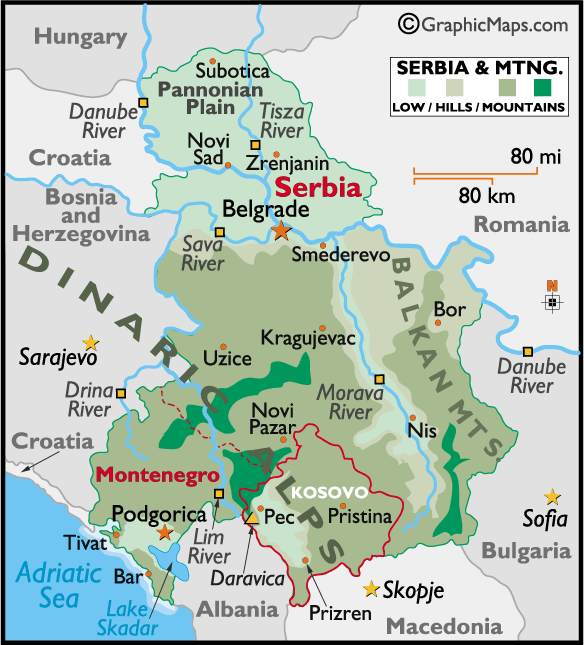
http://www.camperado.com/campgrounds-list/camping-serbia/
Ada Ciganlija is also an excellent place to
kick back and relax during summer. It is as locals call it the sea of Belgrade.
A lot of sport fields and courts (soccer, basketball, golf, volleyball, etc.).
Cafes serving ice cream and beer abound on the banks of this lake-beach park.
Favorite leisure activity in Belgrade is
drinking coffee in numerous bars, bistros and cafés (especially in Strahinjića
Bana street, which is known locally as Silicon Valley as it is frequented by
loud, vulgar and surgically-enhanced folksingers along with their hangers-on and
wannabes). It is very strange, but most of places are occupied all day long - ie,
within working hours. You should check: Downtown café, Buka bar, Movie bar,
Iron café, Biblioteka café, Monza café-boat, Bibis café-boat, and many more;
People who are not in the folk and MTV music, and don't like to drink overpriced
coffee, should avoid this street. There are coffee bars on almost every corner
in Belgrade, which offer more relaxed atmosphere and are designed with more
taste that those in Strahinjića Bana street.
Smederevo is a town about 50 km from Belgrade. There are direct bus lines almost
every half an hour and it takes about one hour to get there from Belgrade. It is
considered as the unofficial rock 'n' roll capitol of Serbia because of its many
rock musicians and bands who live there or were born there. See the largest
lowland medieval fortress in Europe (especially at night when its lights give a
special romantic and mystical atmosphere) or go to a rock concert at "Moto
Club Street Fighter" which is located at the very bank of the Danube. At
the end of September the town hosts a traditional festival called "Smederevska
Jesen" (Smederevo Autumn) which is a festival of vine and Serbian culture
with many concerts and other happenings. During the festival there is a carnival
located at the end of the town but AVOID IT because it's loud and crowded and
basically there's nothing to see or do. Just stay in the town center. Museum of
Smederevo holds a lot of Roman and medieval items and collections so for history
lovers it's a must-see.
Festivals
and nightlife
EXIT festival – Biggest music festival in SE
Europe, that is happening in the beginning of July, in Novi Sad, on Petrovaradin
fortress [25].
Belgrade Beer Fest, which takes place at Ušće
every August [26].
Belgrade
is very famous for its whole-night-party clubs. If you are looking for a place
to feel the local atmosphere and good vibes, visit bohemian street “Skadarlija”.
Please have a look at the Belgrade
article for further options
New Year's Eve
Restaurants, clubs, cafe's and hotels are
usually full-booked and organize New Years celebrations with food and live
music.
However, Serbian New Year's celebrations are
most known for the outdoors festivities in Belgrade, and several other major
cities such as Novi Sad, Niš and Jagodina. As of mid-December, cities are
extensively decorated and lit. The decorations remain until way into January due
to the persistent influence of the old, Julian calendar. Throughout the region,
especially amongst former Yugoslav republics, Belgrade is known as the place to
be for major parties, concerts and happenings. It has become common for large
groups of Slovene's to visit their former capital and celebrate the beginning of
a new year. Especially since the mid-nineties, street celebrations grew into
mass gatherings with hundreds of thousands of people, celebrating New Year on
one of several locations throughout Belgrade.
Also, on January 14th Serbians celebrate so
called Serbian New Year, which is actually New Year's Eve by Eastern Church
calender. In the night between January 13th and 14th you can actually re-live
New Year's Eve.
Buy
Downtown Belgrade is populated with many
high-end as well as midrange shops. "Knez Mihailova" is the biggest
shopping street, but there are also quite a few shopping malls, such as Delta
City and Ušće Shopping Center. Imported western food is available in many
supermarkets, especially in the Croatian-owned "Idea". In nearly all
Serbian pharmacies (apoteka) you can buy prescription drugs without
prescription.
Eat
When ordering a burger ask for 'pljeskavica'
(pronounced approximately: PYES-ka-vitsa) ask for kajmak (like mildly sour
cream) (pronounced: KAI-mak) it tastes way better than it sounds. Stepin
Vajat and Duff at Autokomanda, Loki in downtown area
and Iva in Žarkovo are the best grill fast food restaurants in
town. Also try ćevapi or ćevapčići (pronounced: chay-VAH-pee,
chay-VAP-chitchee), they are small parcels of minced meat, grilled with hot
spices. It is considered a local fast food delicacy. Highly recommended to
carnivores.
Burek (pronounced BOO-rek), sometimes decribed
as the Balkan equivalent of McDonalds due to its being sold everywhere, is very
delicious. It is made with a range of fillings including meat, cheese, spinach,
apple, cherry....... Not for dieters as it is quite oily. Morning is definitely
the best time to eat this (sometimes sold-out by afternoon).
- Kiflice
(KEE-flitsay)are lovely little crescent rolls.
- Paprikaš
(PAP-rik-ahsh) - stew with paprika often with chicken
- Gulaš
(GOO-lash) - stew with paprika with beef
- Sarma
(SAR-ma) cabbage rolls, similar to dolmades but made with sauerkraut instead
of vine leaves
- Gibanica
(GHEE-ban-itsa) - phillo pie with spinach and cheese or just cheese (like
spanakopita or tiropita in Greece)
- Punjene
Paprike
- stuffed peppers (POON-yennay PAP-rik-ay)
- Pohovane
Paprike
(PO-ho-vah-nay PAP-rik-ay) - paprika rolled in soya oil and wheat flower and
fried in sunflower oil, for vegetarians
- Pasulj
- (PAS-ooy) - beans -a national specialty. Often cooked for a long time with
onion and paprika. Delicious.
- Riblja
čorba
- (RIB-yah CHOR-ba) Fish soup using freshwater catch.
- Roštilj
(ROSH-teel) - barbecue - the most delicious food in the world
- Prebranac
(pre-BRAH-nats) - is for vegetarians. It's cooked and roasted beans with
various spices and vegetables. Usually completely meat free.
- Alva
- a sweet of Turkish origin. Made of sugar and nuts.
- Proja
(PRO-ya) - a type of corn bread with white cheese. A national specialty.
Drink
- Rakija
(excellent brandy that has many flavours, like plum (pronounce like
SHLYEE-va), quince (DOO-nyah), apricot (KAI-see-yah)... - You should know
that some prestigious brand of rakija can be extremely expensive like Žuta
Osa (ZHOO-tah O-sah) which means Yellow Wasp or Viljamovka (VEE-lyam-ovka)
made of pear of the sort william , the most expensive and the most
quality ones have a pear fruit in the bottle.
- Loza
(from grapes, a type of rakija)
- Voda
= Water
- Slivovitza
(the national brandy of Serbia, and the most common type of Rakija, very
popular, variably strong alcoholic beverage)
- Beer.
I believe that Jelen (Deer) and Lav (Lion) are the two best varieties of
Serb beer, although Nikšićko from neighbouring Montenegro also seems
very popular.
Tap water is perfectly safe to drink, and
mainly of a good quality, too. There are also many springs and fountains with
excellent-quality drinking water - the most popular ones being the fountain on
Knez Mihailova in Belgrade, and the many fountains in the city of Nis.
One must pay attention when it comes to water in Vojvodina. Some regions (
Kikinda, Zrenjanin..) have heavily polluted water, that is not even used for
cooking, only as technical water.
Stay safe
Serbia is generally a very safe place to visit.
The locals are incredibly polite and helpful in case you require any assistance.
However, you should always be aware of pickpockets, mainly in crowded tourist
places and on public transportation. Street robberies, murders, or attacks are
highly unusual even in dark or remote parts of the city. One should always watch
out for drivers, who can be very rude to pedestrians or cyclists.
Respect
Since many Serbs feel nationally frustrated by
the recent historical events in the Balkans, it is best to avoid discussion of
the 1990's Yugoslavian Wars, the NATO bombing of Serbia, and president
Milosevic's administration. If someone brings the topic up, try to avoid giving
any strong opinions until you can assess your acquaintance's views. Do NOT
mention Kosovo. Due to the US's vocal support of Kosovar independence, in
addition to the 1999 air strikes, there is some ill-will directed towards the
West, particularly towards the USA (though unlikely on a personal level). On the
other hand, talking about Socialist Yugoslavia and Tito will not raise as many
eyebrows; as most will not hesitate in talking about it and some may even
approach it with a strong degree of affection towards that more stable and
peaceful era. Remember Serbia does not recognize the independence of
Kosovo, but does maintain relations with Slovenia, Croatia, Bosnia, Montenegro,
and Macedonia.
Similar to other ex-Yugoslavia countries, Serbs
do not like their country to be described as part of "Eastern Europe".
Another common misconception is that Serbia was part of the Soviet Bloc (in fact
it was part of Yugoslavia that notoriously split with the Eastern bloc back in
1948). People have no problems talking about the communist period or Tito and
often become nostalgic over it.
When toasting in Serbia, as in the most of
european countries, make sure you make eye contact. You may be invited to drink
gallons, but are expected to be able to hold your drink. Being obviously drunk
is a sign of bad taste, lack of character, and worse. It is always nice to toast
in your companion's native tongue. Cheers is živeli in Serbian, gëzuar
in Albanian (Don’t confuse these two, or you will be in trouble!) and egészségedre
in Hungarian.
The word molim is key to polite
conversation in Serbian. It basically means please, but also you're
welcome, an appropriate response when somebody thanks you (and says hvala).
It also means I beg your pardon?, when you didn’t understand some word.
Just saying Šta? (What?) can sound rude. It may be said that the
use of the word molim is similar to the use of bitte in German.
Like most European languages, has the formal
and informal way of saying you (Vi and ti). Use the formal Vi
version when addressing older people. People are normally not addressed or
referred to by their first names, unless among friends or relatives.
Serbian greetings are: Dobro jutro = Good
morning | Dobar dan = "Good day" indeed to be used most of the day |
Dobro veče = Good evening | Doviđenja = Bye | Laku noć = Good
night (only when going to sleep, otherwise Dobro veče) | Ćao = Hi, The
most common informal greeting, used both when coming and leaving.
Belgrade, Serbia Average Weather
 |
||||||||||
|---|---|---|---|---|---|---|---|---|---|---|
| Month | Average Sunlight (hours) | Temperature | Discomfort from heat and humidity | Relative humidity | Average Precipitation (mm) | Wet Days (+0.25 mm) | ||||
| Average | Record | |||||||||
| Min | Max | Min | Max | am | pm | |||||
|
|
|
|
|
|
|
|
|
|
|
| Jan | 2 | -3 | 3 | -25 | 20 | - | 85 | 75 | 47 | 14 |
| Feb (review plan) | 3 | -2 | 5 | -21 | 21 | - | 83 | 67 | 46 | 13 |
| March | 5 | 2 | 11 | -14 | 30 | - | 77 | 56 | 46 | 12 |
| April | 6 | 7 | 18 | -6 | 31 | - | 72 | 49 | 54 | 13 |
| May | 7 | 12 | 23 | -1 | 34 | - | 73 | 51 | 74 | 14 |
| June | 9 | 15 | 26 | 6 | 37 | Moderate | 74 | 51 | 96 | 13 |
| July | 10 | 17 | 28 | 8 | 39 | Medium | 71 | 47 | 61 | 9 |
| Aug | 9 | 17 | 28 | 8 | 39 | Medium | 73 | 46 | 55 | 9 |
| Sept | 8 | 13 | 24 | 2 | 42 | - | 76 | 47 | 50 | 8 |
| Oct | 3 | 8 | 18 | -7 | 35 | - | 82 | 58 | 55 | 11 |
| Nov | 3 | 4 | 11 | -8 | 23 | - | 85 | 71 | 61 | 14 |
| Dec | 2 | 0 | 5 | -19 | 21 | - | 85 | 76 | 55 | 14 |