Belgium Diary


Page Contents - Ferry Crossing - Armentieres - Brugge - Oostende - Ypres (Ieper)
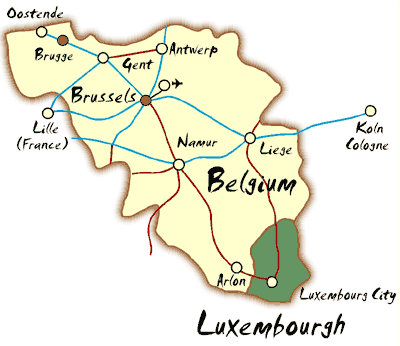 As we drove off the ferry we had to keep reminding
ourselves that we had to drive on the wrong side of the road, and look to the
left on roundabouts instead of the right as we drove around them anti-clockwise
instead of clockwise! We were in France! There were no passport or other
checks as we came off the ferry. We drove slower than the limit on the motorway
just to get the feel of it all and have a look around at the same time.
As we drove off the ferry we had to keep reminding
ourselves that we had to drive on the wrong side of the road, and look to the
left on roundabouts instead of the right as we drove around them anti-clockwise
instead of clockwise! We were in France! There were no passport or other
checks as we came off the ferry. We drove slower than the limit on the motorway
just to get the feel of it all and have a look around at the same time.
After fuelling up - 'gazole' being diesel we found out after asking, we put one
of the Aires in the GPS and drove there. We were going to stay in one near a
town called Cassel, but luckily Dave had spoken his limited French to a
council worker doing some work at the place and when he realised we intended to
stay there overnight, he was able to communicate to us that it was a noisy place
right beside the busy road and there was a better place nearby. He hopped in his
little work car and we followed him to a lovely spot that was quiet and lovely,
a bit off the roadside and on top of a hill overlooking a picturesque valley. We
were a little wary, wondering if he was taking us to a secluded place to set us
up for some criminal activity later but there were a couple nice houses directly
across the road, unlike the other place that had no houses close by - so we were
happy that there was no ulterior motive (suspicious!).
We've read in the Aires book of listed sites, that these Aires have been
provided for motorhome ('camping-car') people, providing facilities for
motorhomes in the form of overnight parking and/or Service Point for water
collection and disposal of waste fluids. French law forbids caravans and tents
from using these motorhome-only Aires - don't know the reason behind it.
15-9-2011 Thursday
Left our lovely quiet spot and drove to a town called Armentieres, just
over the border from France into Belgium. We realised we've been overseas
for a week and already, we've been in 3 countries - will have slept in 3
different countries 3 nights in a row! Howzat for travelling! We stopped and had
a little walk around as Dave spotted an interesting looking building with an
ornate clock tower - it ended up being the Office de Mairie (city council
building).
Drove to a town called Warneton
(Belgium) where there was a cafe that
also housed a telephone museum (Dave had found this out before we'd left home).
However, the cafe was closed when we got there with a sign on the door that it
opened at 4pm (in an hour and a quarter) so went for a walk and a drink at the
local pub. When we walked back it still wasn't opened and we found out that the
guy was away on hols overseas! (a bit ironic) Anyway, a silver lining is the
belgian chocolate shop close by and we indulged ourselves. Well, I think we've
found the next obsession - after cornish pasties! Yummmm!
We drove to an Aire at Harelbeke, in the grounds and outside the main
building of a sports facility (with water and electric only available). We met a
nice couple about our age who helped us with a few things, as they've done quite
a bit of travelling.
16-9-2011 Friday
We had a slow, liesurely morning and left about 11am. We headed for a Fiat
repairer place as a warning light appeared on the dash (to do with the ignition
system). Couldn't find the repair place but when we started back up after
stopping to enquire, the warning light had disappeared - so we continued on to a
camping park called Klein Strand in a town called Jabbeke (thought
it sounded like something out of Star Wars like Jar Jar Beky or Jawooky) in the West
Flanders district (still in Belgium). The park is quite large and spacious -
big 100 sq m pitches, divided by hedges and trees on 3 sides. The language here
appears to be dutch although still in Belgium but apparently only about 50k from
the Netherlands (Holland) border. We're staying here for 3 nights as we plan to
catch the bus into Bruges tomorrow and do some touristing.
17-9-2011 Saturday
We walked a couple hundred metres down the road and caught the bus into Bruges
(Brugge) (pronounced as in 'rouge'). When you first get of the bus at the
bus station hub, you walk across the road to a large markets (only on Saturday
til 1pm), with everything you'd expect - clothes, food, watches, etc. Quite a
few of the stall operators use motor home type vehicles, specially fitted out to
roll out their particular type of goods from the side of the vehicle - very
modern and efficient. One of the delicatessan type stalls featured blood sausage
that Dave has taken a liking to so we had to buy that.
This medieval town is one of Belgium's most popular destinations and well worth
facing the tourist crowds. By the 14th century, Bruges was one of Europe's
leading trade centres but during the following century, the waterway linking the
city to the sea silted up. Despite attempts to build a new canal, Bruge's
economic lifeline was gone. Traders and townsfolk abandoned the city, leaving it
suspended in time. We took a 30 min boat ride in the canal, of which 12k is
accessible by boat. The driver said 30-40k of the canal used to be accessible
before road bridges were built over them. Riding in the boat was like being in
Venice - seeing many houses dating as far back as the 14th century, with water
for a front yard. One of the bridges we passed under was 600 yrs old, and we
think the Story Bridge is old.
Bruge's nerve centre is the historic Markt, a large open square from
which rises Belgium's most famous Belfort (Belfry) with a stiff climb up
366 steps. Tourists kept the many horse and buggy rides busy in and out of the
square. The Burg is another and one of the city's handsomest squares,
where Bruges has been governed for more than 6 centuries from its 14th century
city hall. The Burg also features the Heilig-Bloedbasiliek (Basilica of the
Holy Blood) where a few coagulated drops of Christ's blood are kept and
cherished. Bruge's prized collection of art dating from the 14th to 20th
centuries is housed in the small Groeningemuseum. The Onze Lieve
Vrouwekerk (Church of Our Lady) has one remarkable art treasure:
Michelangelo's Madonna and Child. This small marble statue (1504) was the
only work of art by Michelangelo to leave Italy during his lifetime.
Don't wear your high heels ladies - the streets are paved with cobble stones
instead of bitumen and the car parks on the side of the road, instead of being
outlined in white paint, are marked with white cobblestones - put me in mind of
a big mosaic. There were many chocolate shops but Dave wouldn't let me go in
any! There'll be plenty more....... We hadn't had any lunch so we had an early
dinner about 4pm in one of the many restaurants. Dave ordered mussels in garlic
sauce and this big black pot came out and it was filled with many mussels in
their shells - Dave thought he was in heaven! The day had been overcast and a
few sprinkles came down every now and then but mostly the rain held off until
after we bussed it back home.
18-9-2011 Sunday
Had a liesurely day today with a late breakfast. Got our bikes out at 2pm and
rode around the streets to get us back into it again - didn't take long to
develop that familiar 'bum tenderness' which will disappear with much more bike
use. We rode to a supermarket which was closed as it's Sunday - haven't caught
up with the Sunday traders as in OZ. We got home after a little over an hour and
relaxed outside with our drinks and nibblies.19-9-2011 Monday
Drove to an Aire at Westend-Bad on the coast. Belgium's coastline is only
65k. Our parking spot is on the esplanade, room for about 6 mhomes. Our Aires
book quoted 50 spaces available but this has obviously been changed and as we
were here early about lunchtime, we got a park. We got the bikes out and rode
along the flat, spacious, paved esplanade lined with many shops. Although there
may be many more attractions during season, we can't report that it was very
interesting and it was quite windy. The area between Westend-Bad and Oostende
was obviously being scaled down for the winter months with many of the
attractions closed - the Casino looked open though. After 1 and a half hours our
bums were a bit sorer than yesterday - still not bicycle-seat run in yet.
19-9-2011 Monday
Drove to an Aire at Westend-Bad
on the coast. Belgium's coastline is only 65k. Our parking spot is on the
esplanade, room for about 6 mhomes. Our Aires book quoted 50 spaces available
but this has obviously been changed and as we were here early about lunchtime,
we got a park. We got the bikes out and rode along the flat, spacious, paved
esplanade lined with many shops. Although there may be many more attractions
during season, we can't report that it was very interesting and it was quite
windy. The area between Westend-Bad and Oostende was obviously being scaled down
for the winter months with many of the attractions closed - the Casino looked
open though. After 1 and a half hours our bums were a bit sorer than yesterday -
still not bicycle-seat run in yet.
20-9-2011 Tuesday
Drove to Oostende also on the coast and looked an interesting town so we
parked in an Aire (Oostende 1) and rode around (feels a lot better
today). Saw a lovely, ornate church/cathedral (don't know which as couldn't read
the language) St Peters and Pauls (being renovated so couldn't go
inside), an old clock tower across the road, and rode around the small harbour
and a marina with expensive yachts and a tall ship. Bought a seafood lunch from
one roadside stall of about 4-5 - interesting array of small made up
ready-to-eat trays of large and small prawns in different sauces, mossels
(mussels), seafood extender and fried items - very inviting. Had to keep an eye
on the 'giant seagulls' which are more than twice the size of our seagulls - big
enough to roast! We saw an interesting old building which was the railway
station.
We then drove to an Aire Oostende 2 which has many large parking bays for
mhomes in an industrial area and close to Fort Napoleon. So we got our
bikes out again and rode there. Napoleon built this fort as defence against a
possible invasion from England. A British invasion never came, and the fort was
completed only upon the fall of Napoleon in 1814. During the two world wars, the
fort was used by the German military. After the liberation, however, it fell
into disrepair. Since 1995, Fort Napoleon has been supported by ''Erfgoed
Vlaanderen" (Flanders Heritage) that sees to the restoration and has turned
it into an hospitable spot.
Just to show how big the Aire is we're staying in, while I've been typing this,
3 18 wheeler semi-trailers have just driven in to probably park for the night
and there's about 15 mhomes already parked here, and there's still room probably
for more than the same number of vehicles again.
21-9-2011 Wednesday
Drove to a town called Ypres (Ieper) (although it's often written with
the capital 'I' like a small 'l' so it looks like 'leper' - this is how it
appears on the map) about 85k away and booked into a park Jeugdstadion
for 2 nights. Walked into the main part of the town about 900m away - Ypres' hub
called the Grote Markt which is basically a big open square, used for car
parks in the middle, surrounded by shops, pubs and eateries. We walked around
the shops, and visited the enormous St Maartens Kathedraal which had a
very high ceiling of about 40-50 metres, large round stone pillars holding up
the ceiling, several separate chapels inside, large marble pulpit and marble
altar, and many beautiful stained glass windows. Bought some more chocolate from
one of the many chocolate shops. They make all sorts of things out of chocolate
- like a bottle of beer and a beer glass, animals (in Bruge there was a large
aardvark with large ants), fruit, veges, just about everything.
Ypres was the last bastion of Belgian territory unoccupied by the Germans in
WWI. As a result, this southwest corner of the country was a barrier to a German
advance towards the French coastal ports around Calais. More than 300,000 Allied
soldiers were killed here during the four years of fighting that left the
medieval town flattened. The Menin Gate (which is actually a large
sandstone arch spanning Menin road leading into the Markt) is perhaps the
saddest reminder of the town's tragic past. The huge white gate is inscribed
with the names of 54,896 British and Commonwealth troops whose lives were lost
in the quagmire of the trenches and who have no graves. Every evening at 8pm,
traffic is halted while buglers sound the Last Post.
22-9-2011 Thursday
We rode down the road away from the main town, to a military cemetery that
displays the resting places of many allied forces soldiers. The cemetery was
very well kept with roses and other flowers in narrow gardens lining the front
of the gravestones. It made us proud to see the 'rising sun' emblem on the
Australian soldiers gravestones, and sad at the same time to see how young so
many of these soldiers (from many countries) were.....
We then rode back into the main town to Flanders Museum in a very large
ornate building called Cloth Hall which was severely damaged during the
WWI bombings. The museum is dedicated to the 1914-1918 World War and largely
praises the allied soldiers from many countries who came and fought alongside
the Belgians. The museum was moving and a bit confronting and we spent over 2
hours looking, reading, and listening to the displays. It is hard to get a sense
of how tough it was physically and mentally for the infantry troops on both
sides, in the trenches, facing each other for close to three years without any
substantial advance or retreat. When you have been through the museum and when
you see the hardship and how difficult it must have been when soldiers thought
"what are we doing here?!", you start to realise how awful it must
have been.
The Cloth Hall (Dutch: Lakenhal or Lakenhalle), was one of the
largest commercial buildings of the Middle Ages, when it served as the main
market and warehouse for the Flemish city's prosperous cloth industry. The
original structure, erected mainly in the 13th century and completed 1304, lay
in ruins after artillery fire devastated Ypres in World War I. Between 1933 and
1967, the hall was meticulously reconstructed to its prewar condition, under the
guidance of architects J. Coomans and P.A. Pauwels. At 125 metres in breadth,
with a 70-metre-high belfry tower, the Cloth Hall recalls the importance and
wealth of the medieval trade city.
100 metres down the road was a small church called St George's Memorial
Church. On each of the congregational chairs sat a cushion with a
cross-stitched cover, showing various countries' military units or
battalions/regiments. Nearly every item in the church has been given in memory
of either an individual or a regiment. From the day of its opening in 1929, the
church has been a living, worshipping church for the British community resident
in the area and the many thousands of pilgrims who come to Flanders from all
parts of the world.
(I should explain about Flanders and Wallonia. Belgium is a country of 2 halves,
2 identities and 2 distinct topographies. The northern half of the country is
known as Flanders, and has the country's quota of coastline (only 65k).
The landscape is flat with cycle lanes that go everywhere and Flemish is spoken.
The dividing line cuts across the country South of Brussels. The South, known as
Wallonia, has forested hills and small villages that look the same as
those seen in France. French is widely spoken.)
We had dinner at a Frituur which is a hot chip shop, went to a corner pub
for a drink near the Menin Gate and waited for the 8pm Last Post ceremony. There
were many people there which we were surprised at, seeing as it happens every
night, but maybe a lot of them were tourists like us! After that we rode on home
and glad to do so as we were quite tired.
23-9-2011 Friday
Left the park about 11am and drove to the 5th Battalion Australian Memorial
which had many gravestones and right across the road was the smaller Polygon
Wood Memorial. All the memorials and military cemeteries are very well
maintained by the Commonwealth War Graves Commission.
We continued on a couple kilometres to the Tyne Cot Cemetery, the largest
Commonwealth cemetery in the world. It is also the most important reminder of
the bloody battle of Passchendaele. During the British offensive of 1917,
tens of thousands of soldiers died here in a period of one hundred days for a
gain of barely 8 kilometres. Originally 'Tyne Cot' was a bunker on the German
Flandern line. On 3 October 1917, Australian soldiers captured the position and
used it as an advanced dressing station. Soldiers who died of their injuries
there were buried on site. Before long a small cemetery had come into being with
some 300 graves. There are 2 concrete and steel bunkers still intact at the back
end of the cemetery.
Between 1919 and 1921, specialist units called Exhumation Companies, brought
almost 12,000 dead to Tyne Cot from the surrounding battlefields. Most of their
names are unknown. The cemetery was inaugurated in 1927. The rear wall of the
cemetery is a Memorial to the Missing. It bears the names of 35,000 British and
New Zealand servicemen who fell in the vicinity after 16 August 1917. The Tyne
Cot Memorial continues the list of names inscribed on the Ypres Menin Gate.
Every year over 180,000 visitors from all over the world, come to Tyne Cot
Cemetery.
Neither of us really understood the magnitude of our countries involvement here
and staggering loss of Australian young lives. We saw market gravestones of
Australian infantrymen many of whom were 2nd Leutenant at 19 years, another a
captain at 22. We wondered what it must have been like for the population back
home, when about 250,000 young soliers were lost here and Gallipoli. Compared to
todays'population that equates to approximately 1.25 million; Of course,
conflicts are fought very differently now with much more reliance on technology
and less face-to-face engagement.
After our solemn visits, we tried to find a place to stay for the night. The
first one we tried we found in our Sat Nav, and it said there was one in the
main town of Brussels, which we thought was great, but we shouldn't have
believed it! It might have been some building with a club in it but there was no
caravan park. We were in busy traffic and at times, going down streets with cars
parked on each side and only just enough room for our mhome! We were also
starting to get into peak hour traffic and it's a real fight merging with the
traffic on busy streets and roundabouts. They also have many tunnels that go
under, and allow you to bypass, busy intersections. We were afraid to use them
initially but then saw they had high ceilings so tried them - they were great
but satellite signal loss caused us some concern in relying on our GPS
navigation.
The next one we tried at a town called Grimbergen, had no vacancies so we
contined on another 12ks to a park called 3.R.C.B. at a town called Wezembeek-Oppem,
and luckily they had a vacancy - we were starting to get desperate as it was
nearing 6pm. We're going to stay 3 nights as we can train it into Brussels for
our sightseeing.
24-9-2011 Saturday
Rode to the local train station late morning. We chained our bikes up and caught
the train into the centre of Brussels. Bought hop-on-hop-off tickets on a
1 and a half hour sightseeing bus tour which was very good. It's unbelievable
how these big buses, and the many banana buses, manoeuvre around some of the
small streets and corners! We were sitting upstairs right in the front and I had
to catch my breath a few times but we didn't hit one vehicle or other obstacle
no matter how close we came - I was impressed! Visited another big beautiful and
ornate cathedral - St Michaelis. It had many complex stained glass
windows, again several chapels and a very impressive pulpit, quite tall and made
of carved wooden figures holding up the actual area where the priest stands, and
2 sets of steps leading up with fancy carved railings. We walked around the
streets, marvelling at all the magnificent centuries-old buildings. There were
quite a few modern buildings as well but greatly outweighed by the old.
We had a late lunch of a quite nice pizza at a pizza hut and considered how easy
it is to lose your bearings in a place where streets aren't laid out in an
ordered pattern, but shoot off in all angled directions. We caught the train
back, got our bikes and as we rode past a shopping centre and a chinese
restaurant, bought a small number of groceries and some takeaway for dinner.
25-9-2011 Sunday
Rode our bikes to the train station again today and went into Brussels. Never
thought I'd ever be able to say this but I bought some genuine, authentic
brussel sprouts in Brussels today. We looked around an antique markets that were
set up in stalls set up in tents in an open area - Dave was disappointed as he
didn't find any old phones. Lots of people were milling around on a leisurely,
beautiful, sunny Sunday and lots of eateries were open and being well
patronised. We had coffee inside a coffee shop and were entertained, watching 2
guys at a table outside, watching girls walk by (think we're getting old). Again
we marvelled at the architecture and ornateness of the buildings, especially the
churches - words just can't fully describe.
We bought hot escargot in a sort of soup from a roadside stall. They were very
chewy and pretty tasteless and I can't see the attraction - yuk!. I had one and
had to spit it out after a while of chewing and chewing and chewing, and not
getting anywhere with it. Dave ate the rest. Close by was the famous statue of
the little boy peeing - called "Manneken Pis". This was even on
the directional street signs with the ones to show you in which direction to
find a cathedral or the Justice building. I thought we'd made up that slang word
for that bodily function but it's been around for centuries! The statue is
small, only a little more than 1 foot tall and is set atop a fountain behind a
metal fence. Many tourists were getting their photo taken in front of it -
including us! Today it had maroon clothes, cape and hat on which later we
realised was part of some entertainment. About 8 young guys came along, all
dressed the same way and singing in a language we didn't understand but it
certainly seemed to be a fun song and the boys seemed to be enjoying themselves.
There were plenty of souvenir shops in close proximity to this famous statue,
and of course you could buy so many different souvenirs featuring this famous
icon. There were many chocolate shops around here too, as there are everywhere -
of course, this is Belgium - the chocolate capital of the world! But one of
these chocolate shops had this statue in the window - peeing chocolate! And of
course you can buy little chocolates in this form as well. Below is a blurb Dave
found on the net about this famous icon.
New
York has the Statue of Liberty, Copenhagen has the mermaid and Brussels has the
...... Manneken Pis. This statue of a little boy in a somewhat compromising
position has since several centuries been a major tourist attraction in the
city. When most people see our 'manneken', the first reaction is always one of
amazement: "Look, how small he is ! Why does everybody want to see him
?" The people of Brussels, however, accept him the way he is. After all, it
doesn't always have to be big to be beautiful. Imagine he would be the size of
the Statue of Liberty : Brussels would be continuously flooded !
Nobody
actually knows why the manneken is there. He is believed to be nothing more than
a decoration on top of a fountain, where people in the Middle-Ages came to get
fresh water. Already in the 15th century a fountain called 'manneken-pis' existed
in the Stoofstraat/Rue de l'étuve. The official origin can be traced back to
the 13th of August 1619 when the city ordered the sculptor Jerome
Duquesnoy to make a new bronze statue of manneken-pis to replace an old and
withered one. During the course of the centuries our little manneken has often
been hidden to protect him against bombs of invading armies. He has also been
stolen several times by plundering soldiers and even by the citizens of Geraardsbergen,
a city in Flanders that claims to possess the oldest statue of a peeing boy in
Belgium.
A lot of
people do not know that the manneken-pis is very often dressed. At the moment he
has a wardrobe of more than 600 costumes, which are all preserved in the
King's House, or City Museum at the Grand-Place, the central market square of
the city. He received his first costume on May the 1st 1698. The governor of the
Austrian Netherlands gave the costume on the occasion of festivities organized
by one of the guilds of Brussels. Many more costumes were to follow. Even
nowadays he still receives new gear when folklorist groups visit Brussels. To
thank them for the gift, the manneken offers the people of such groups beer
which comes directly from a beer barrel attached to the statue. Among the more
special costumes are for instance : an Elvis Presley outfit and a Mickey Mouse
costume.
There
are many legends about the Manneken. According to one of them a little
boy had watered against the door of a witch who lived where the fountain now
stands. The witch was so angry that she turned the little boy into a statue.
Another
legend says that a man had lost his little son. He found the child after two
days near the place where now the fountain of manneken-pis can be seen. When the
father spotted his child, the latter was peeing. As a token of gratitude the
father had the fountain with a statue of a peeing boy constructed.
If the
sight of manneken-pis inspires you to new legends, don't hesitate to contact the
city authorities!
26-9-2011 Monday
We drove to Antwerp to a camp site but they couldn't take us so sent us
to another site of theirs that is for m/homes called Campers Vogelzang, a
few kilometres away. It doesn't have showers or toilets but does have power for
which you pay separately. It's a nice, grassed, fairly flat open site and is
only about 4k from the main town which is good as we can cycle that. We got to
the site by mid afternoon so had time to roll out the awning, get the table and
chairs out and have drinks and nibblies (we've been home too late lately to do
that and we've missed it!).
27-9-2011 Tuesday
Dave drove me to my early afternoon dental appointment today in Deurne
about 20 mins away. One of my big teeth has had a very fine crack in it for some
time and wasn't giving me too much trouble until 8 days ago, when I bit on
something and (must've been the final straw) made that crack a bit bigger which
wasn't easy to live with anymore. Luckily I got an appointment with a dentist
who speaks English and was able to do a temporary fix until I go home. I was
home for 4 months and it had to happen 12 days after we got here! Oh well, Cést
la Vie!
When we got back to the park we put our dirty washing in 2 plastic bags, hopped
on our bikes and rode about 2k down the road to a laundromat. It's always fun
learning new machines everywhere we go - not! I managed to put it on with the
help of a lovely young lady (who thankfully spoke English) also doing her
laundry, and we wandered down to the corner bar and had a drink while we waited
- what a civilised way to do the laundry! I then walked back to take the washing
from the machine and put it into the dryer, (seeking more help from the young
lady, about the workings of the dryer), while Dave ordered another drink for my
return. We loaded the full bags on the back of Dave's bike carrier, and rode
back home. After folding said laundry (having lost 1 sock - damn machines!) we
walked a couple hundred metres down to the corner restaurant called 'Bows', and
had a lovely dinner, happy that I was able to eat on the left side of my mouth
for the first time in a week.
So we didn't do too much of note today but we still had a good day and enjoyed
ourselves.
28-9-2011 Wednesday
Rode our bikes into the main town of Antwerp today, about 4k, to explore. We saw
the magnificent Kathedraal Notre Dame (Cathedral of Our Lady) - funny,
when I saw "Notre Dame" I thought that's in France with Quasimodo. I
never really thought that there are probably many cathedrals called "Notre
Dame" as it just means "Our Lady". We went to the Grote Markt
which every town seems to have as it just means "Great Square", and it
had a very ornate fountain in the middle. The city hall also lined one side of
the square with about 60 flags hanging from the front wall, and we weren't too
happy as we couldn't see OZ's! We also went on a sightseeing tour on a 3 car
tram, a "clayton's tram" as it had real wheels not tram ones. Oh,
another chocolate shop - have to stock up! I feel so sad about when Dave checked
out the Belgian Beer shop with about 275 varieties, but we could only carry
chocolate on the bike.
We had a very nice doner kebab (no cornish pasties in Belgium) for lunch at one
of the many eateries that line the streets. We rode down to the Maritime
Museum which was free, and had many old big and small boats - some of the
smaller ones were finely crafted with a beautiful polished finish. We rode home
along the waterfront road way where there was big cruise liner in dock
(mmmmmm..... thinking about our next holiday already..) We ended up riding about
10k and got home about 4pm, in time to enjoy the last of the beautiful sunshine
and warm day. We've been told this warm weather is quite unseasonal - it usually
is getting quite cool by now - we tell them we've brought the sunshine from OZ.
28-5-2012
Monday
Drove 335ks west to a
town called Comines-Warneton
in Belgium, to a cafe called Café
L'Hotel de Ville where the owner has a telephone museum in glass display
cabinets, inside the cafe. We actually came here when we first arrived in
Belgium in September 2011 but the cafe was closed, with the owner being away on
holidays - a bit ironic, with us coming to see him on our holiday, and him being
away on his own holiday! Anyway today, he was home and he, Daniel, happily
welcomed us in to view his collection. Luckily we arrived when we did - in
another 20 minutes he would've been closed for 2 hours til the next late
afternoon session, and we couldn't have waited around for that. He is retired
but was apparently a professor in electronics, and telecommunications and the
old beautiful phones, attracted him. He had a nice collection of antique
phones with some being quite rare.
We then tried to drive
to an Aires about 5ks away, near a church in a town called Messines.
However, the main road to there was closed for repair work and our GPS attempts
at rerouting took us down some narrow, one vehicle width roads. In the end,
after coming to yet another road closure from a different direction, we pulled
over to decide our next move. I went into the business building where we'd
stopped to ask for directions. The young lady gave me directions which seemed to
be down some more narrow roads which I didn't fancy, so I asked her for
permission to park in their carpark overnight and she said yes. The business was
called Messines Peace Village which provides hostel type accommodation
for youth, school groups, sport clubs, and individual tourists. It is situated
in the area of Flanders Fields, therefore catering for people who want to visit
the war cemeteries, monuments and museums in the area. They also have a
restaurant, bar and conference rooms for seminars and meetings. Later in the
afternoon a big travel
bus from Great Britain pulled up and from the sounds of it, its cargo is a
group of teenage school girls.